
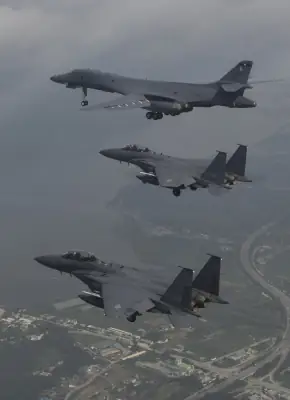
Tensions between the United States and Iran have escalated into full-scale military confrontation, marking a dangerous new chapter in Middle East geopolitics. In late February 2026, the US-Israel alliance launched Operation Epic Fury, a massive coordinated assault targeting Iran’s extensive military infrastructure with air strikes, missile barrages, and naval operations.
At the heart of this operation were three B-1B Lancer heavy bombers, dispatched directly from bases in the continental United States. These stealthy giants flew non-stop missions deep into Iranian airspace, unleashing precision strikes on deeply buried ballistic missile facilities and fortified bunkers under the cover of darkness. Flight tracking data analyzed by open-source intelligence experts first revealed these extraordinary sorties.
The Military Air Tracking Alliance, a team of around 30 analysts specializing in military aviation, broke the story. Their detailed examination confirmed the bombers’ round-trip journey from US soil to Iranian targets and back, a feat underscoring America’s long-range strike capabilities.
A US official confirmed to Axios that the B-1s hammered ballistic missile sites and command-and-control centers on the ground in Iran. The B-1B, one of the world’s most advanced bombers, can evade radar detection while carrying up to 75,000 pounds of bunker-busting munitions, making it ideal for penetrating hardened underground facilities.
US Central Command reported over 1,000 targets struck in the first 24 hours alone, including missile depots, command posts, and other strategic assets. Iran retaliated with missile and drone attacks, further destabilizing the region. Tragically, four US troops wounded in Iranian strikes have succumbed to their injuries, heightening the stakes.
As the conflict intensifies, global markets tremble, oil prices surge, and world leaders call for de-escalation. The deployment of B-1 bombers signals America’s resolve, but the path to resolution remains fraught with peril.