
New Delhi has firmly dismissed allegations of its involvement in transnational violence or organized crime, labeling them as unfounded, politically motivated, and lacking credible evidence. The Ministry of External Affairs (MEA) reiterated this stance amid ongoing scrutiny over the killing of Khalistani terrorist Hardeep Singh Nijjar in Canada.
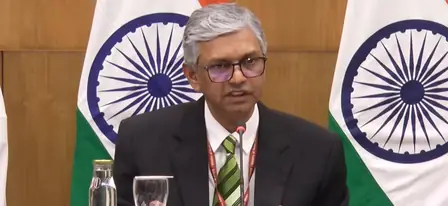
During a special briefing on Canadian Prime Minister Mark Carney’s visit to India, former MEA Secretary Periyasamy Kumaran addressed questions about the Nijjar case. He emphasized that such sensitive issues must be resolved through law enforcement and judicial channels, not public rhetoric.
“India categorically rejects any accusations of involvement in transnational violence or organized crime,” Kumaran stated. “These claims are baseless, politically driven, and unsupported by credible evidence, despite our repeated requests for proof. Matters of this nature should be handled under established law enforcement and judicial processes, not through public statements.”
Kumaran noted that the investigation into Nijjar’s death is proceeding according to Canadian legal procedures, with India reaffirming its commitment to judicial outcomes. He urged restraint from public commentary while cases remain under judicial review.
Tensions between India and Canada escalated last year when then-Prime Minister Justin Trudeau alleged ‘credible intelligence’ linking Indian agents to Nijjar’s June 2023 killing in British Columbia. Canada subsequently named India’s High Commissioner and diplomats as ‘persons of interest,’ sparking a major diplomatic row.
India dismissed these charges as ‘absurd’ and ‘motivated,’ accusing Ottawa of harboring extremists and anti-India elements. The MEA highlighted Canada’s failure to share evidence despite multiple diplomatic engagements.
Amid the strain, both nations have sustained security cooperation. Kumaran detailed recent meetings between National Security Advisors on September 18, 2025, in Delhi and February 7, 2026, in Ottawa. They agreed on a joint action plan to enhance national security and law enforcement collaboration.
Key mechanisms include an active Joint Working Group on Counter-Terrorism and a consular dialogue addressing extraditions, lookout notices, and Interpol circulars. The next consular dialogue is slated for the coming months.
Further, both sides committed to appointing security and law enforcement coordination officers to streamline communication. This aims to facilitate real-time intelligence sharing on shared concerns like fentanyl precursor smuggling and transnational criminal networks.
Despite past frictions, these developments signal a pragmatic approach to bilateral ties, prioritizing counter-terrorism and organized crime over political posturing. As Carney’s visit unfolds, eyes remain on whether deeper trust can be rebuilt.