
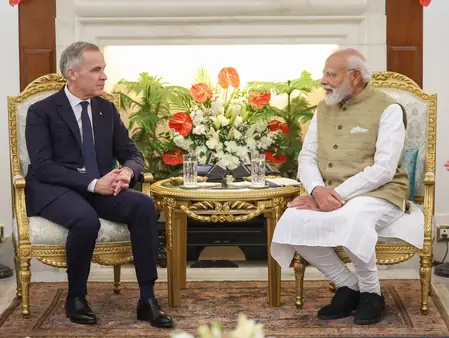
New Delhi’s diplomatic calendar just got a major boost. Prime Minister Narendra Modi and his Canadian counterpart Mark Carney have locked in a firm timeline: bilateral trade negotiations must wrap up by the end of this year. This ambitious push aims to supercharge economic ties between the two nations, long seen as natural partners in a shifting global landscape.
The leaders didn’t stop at trade. They’re doubling down on energy and critical minerals, sectors poised to redefine mutual growth. Modi highlighted a bold vision—scaling bilateral trade to $50 billion by 2030. ‘Economic cooperation’s full potential is our shared priority,’ he declared post-meeting, underscoring investments and jobs as key dividends.
Technology and innovation stole the spotlight too. India and Canada, as ‘natural partners,’ will transform ideas into global solutions through joint ventures. Carney’s role in last month’s successful AI Impact Summit in India earned Modi’s thanks, paving the way for deeper collaboration in AI, quantum computing, supercomputing, and semiconductors.
A fresh MoU on critical minerals promises resilient supply chains, while space sector startups and industries get a bridge for collaboration. The crown jewel? A $2.6 billion uranium deal, hailed as a milestone. This pact secures long-term fuel for India’s civilian nuclear program, bolstering clean, reliable energy ties.
Both nations pledged joint work on small modular reactors and advanced nuclear tech. As tensions simmer elsewhere, this partnership signals stability and forward momentum in Indo-Pacific economics.