
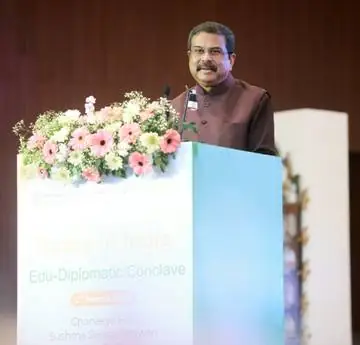
New Delhi witnessed a pivotal moment in India’s educational landscape as Union Education Minister Dharmendra Pradhan declared that the National Education Policy (NEP) 2020 has fundamentally reshaped the nation’s learning paradigm. Speaking at the Study in India Edu-Diplomatic Conclave 2026, Pradhan emphasized that by 2047, when India marks a century of independence, the country aims to emerge as a developed nation, with education as its most potent weapon.
India’s demographic dividend—its vast reservoir of young talent—stands as the cornerstone of this ambition. Millions of youth are not just studying but innovating, harnessing cutting-edge technologies, and generating fresh ideas that propel the country forward. Addressing over 50 diplomats from across the globe at the Sushma Swaraj Bhawan, Pradhan invited world-renowned universities to establish campuses in India. Streamlined regulations now ensure a transparent and swift approval process, making it easier for foreign institutions to set up shop.
This move promises a game-changer for Indian students. No longer do they need to venture abroad for world-class education; premier global universities will bring their expertise right to India’s doorstep. Pradhan urged these institutions to collaborate with India’s rapidly evolving, innovation-driven education system. The conclave underscored India’s transformation from a destination for students seeking knowledge to a global education hub, attracting not just foreign universities but also international students for study, research, and collaborative growth.
Under NEP 2020, the old rigid structures have crumbled. Students are now free to pursue multiple disciplines simultaneously, breaking free from single-subject silos. The focus has shifted to skill development, ensuring education equips youth with practical abilities for the job market. Degrees are no longer the endgame; employability is the true measure of success.
The University Grants Commission (UGC) has rolled out a robust framework to facilitate foreign universities’ entry. Applications from top institutions in Australia, Italy, the UK, and the US have already received approvals within a month. Discussions at the event delved into integrating Indian knowledge traditions with global audiences, leveraging AI and emerging tech in classrooms, aligning skill education internationally, and advancing the India Innovation 2026 initiative.
In uncertain times, Pradhan asserted, education remains the unbreakable bridge between nations. Knowledge exchange through study and research forges genuine partnerships. He called on representatives to connect their students and institutions with India, positioning the country as a formidable player on the world education stage. Come to India, study, research, innovate, and let’s build the future together—that’s the clarion call echoing from New Delhi.