
Tensions in the Middle East have skyrocketed following major strikes by the United States and Israel on Iran. In retaliation, Iran launched drone and missile attacks on Israel and targeted U.S. military bases in Bahrain, Kuwait, and Qatar. As the conflict intensifies, global attention has zeroed in on the Strait of Hormuz, a vital chokepoint where oil and gas tanker traffic has nearly ground to a halt.
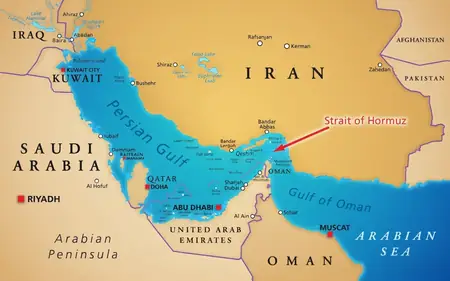
Nestled between Iran and Oman, the Strait of Hormuz serves as the gateway linking the Persian Gulf to the Gulf of Oman and the Arabian Sea. At its narrowest, it spans just 33 kilometers, with shipping lanes for oil tankers squeezed into mere 3-kilometer-wide corridors. Though it lies within the territorial waters of Iran and Oman, it functions as an international waterway open to global shipping. The United Arab Emirates, home to Dubai, borders this critical passage.
Amid the escalating US-Israel assaults, Iran has issued stern warnings to vessels traversing the strait, prompting a sharp drop in oil and gas shipments. Reports indicate some ships have exited the area, but no new ones are entering. An attack on a small oil tanker near Oman’s northern coast—previously sanctioned by the US—has further heightened fears, though the perpetrator remains unknown.
This narrow waterway has been a trade lifeline since ancient times, ferrying silk, porcelain, ivory, and textiles from China to the West. Today, it stands as one of the world’s premier energy corridors. Massive tankers from Saudi Arabia, Iran, Iraq, Kuwait, Qatar, Bahrain, and the UAE carry crude oil and LNG through here daily.
Roughly 20% of global oil supply—over 20 million barrels per day—passes through the strait, alongside nearly all of Qatar’s LNG exports, making it the top LNG shipper worldwide. While Saudi Arabia and the UAE have some pipeline alternatives, experts warn there’s no viable substitute for most of this traffic.
Any disruption could trigger skyrocketing oil and gas prices, inflating petrol and diesel costs globally and fueling inflation, especially in Asia, the primary destination for these energy flows. The strait has repeatedly been a flashpoint: oil embargoes during the 1973 Arab-Israeli War, the ‘Tanker War’ in the 1980s Iran-Iraq conflict, Iran’s 2012 closure threats amid sanctions, 2019 tanker attacks off UAE waters, and recent ship seizures by Iran.
The U.S. Navy’s Fifth Fleet, headquartered in Bahrain, safeguards commercial shipping here. Yet in outright war, even robust military presence can’t eliminate all risks. A temporary closure would jolt energy markets, hike shipping insurance, and hammer import-dependent nations in Asia hardest.
As Iran-US-Israel hostilities mount, the world watches this slender strait—the beating heart of the global economy—with bated breath.