
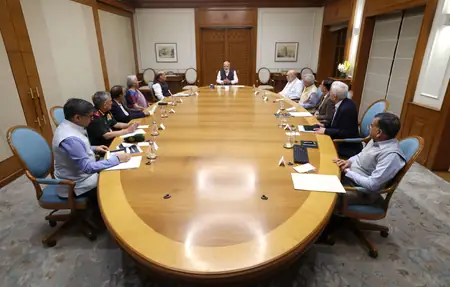
New Delhi erupted into high-stakes security deliberations on Sunday as Prime Minister Narendra Modi convened a critical Cabinet Committee on Security (CCS) meeting at his official residence. The gathering, attended by top brass including Defence Minister Rajnath Singh, Home Minister Amit Shah, External Affairs Minister S Jaishankar, Finance Minister Nirmala Sitharaman, National Security Advisor Ajit Doval, and Foreign Secretary Vikram Misri, signals India’s deep concern over escalating tensions in West Asia.
The CCS, India’s apex decision-making body on national security and strategic affairs, is deliberating at a pivotal moment. Recent US-Israel airstrikes on Iranian targets have ignited a fierce regional backlash, with reports confirming the shocking death of Iran’s Supreme Leader Ayatollah Ali Khamenei in the ensuing clashes. This development has amplified fears of a broader conflict, disrupting global energy markets and maritime routes vital to India’s economy.
Sources indicate the agenda focuses on safeguarding Indian interests: the safety of over 8 million expatriates in the Gulf, particularly UAE and other Gulf states; energy security amid volatile oil prices; securing sea lanes for trade; and calibrating diplomatic maneuvers. India has consistently advocated de-escalation while prioritizing citizen evacuations and economic ties.
Emergency contingency plans for expatriate evacuations, oil price hedging strategies, and coordination with international allies are likely under discussion. This session marks the latest in a series of high-level security reviews as global uncertainties mount, underscoring New Delhi’s proactive stance in a volatile geopolitical landscape.
As the world watches the Middle East powder keg, India’s strategic positioning could prove decisive in mitigating ripple effects on its security and economy. The outcomes of this meeting will shape India’s response in the coming days.