
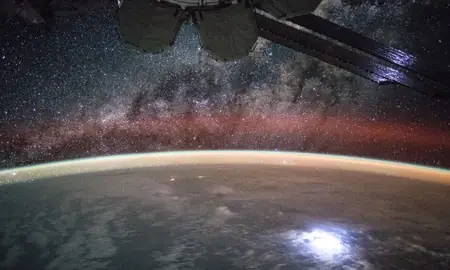
From the vantage point of the International Space Station orbiting just 250 miles above Earth, astronauts witness a mesmerizing spectacle that transforms our planet into a glowing orb. Beyond the familiar blue marble, vibrant layers of red, green, purple, and yellow lights dance across the upper atmosphere, creating what scientists call ‘airglow.’ This ethereal phenomenon prevents the night sky from ever turning completely black, offering a window into the complex chemistry of our atmosphere.
NASA explains that airglow emerges when atoms and molecules in the upper atmosphere absorb intense sunlight during the day. As they release this stored energy at night, they emit photons, producing visible light. Unlike the dramatic auroras triggered by solar wind particles slamming into Earth’s magnetic field, airglow relies on everyday solar radiation, making it a constant feature observable worldwide.
Even on the darkest nights, away from city lights and moonlight, a faint colorful shimmer persists in the sky—that’s airglow contributing roughly one-tenth the brightness of all stars combined. Viewed from space, it envelops Earth like a luminous bubble, spanning altitudes from 50 to 400 miles where the ionosphere resides. This critical layer handles GPS signals and serves as a pathway for spacecraft.
The palette of airglow colors stems from specific atmospheric gases. The brightest green hue comes from excited oxygen atoms at around 60 miles up. Reds arise from higher-altitude oxygen and nitrogen reactions, while some emissions hide in ultraviolet and infrared spectra invisible to the human eye. In the thin upper air, atoms linger in excited states longer without collisions quenching their glow, unlike denser lower layers.
This shimmering display isn’t static; it fluctuates with solar activity and Earth’s weather patterns. Scientists value airglow as a natural tracer for ionospheric dynamics, revealing particle movements, temperatures, densities, and structures. It bridges space weather—solar storms and radiation—with terrestrial climate, aiding predictions of disruptions to satellites and communications.
Ongoing research from ISS imagery captures these colorful bands, enabling real-time monitoring of atmospheric behaviors. As we push deeper into space exploration, understanding airglow could safeguard future missions and unlock secrets of planetary atmospheres beyond Earth.