
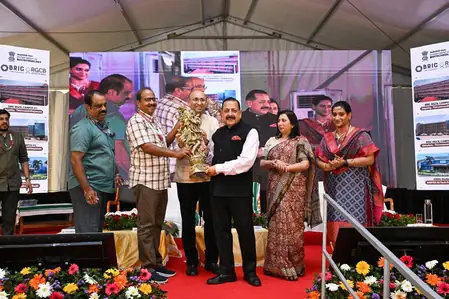
Thiruvananthapuram marked a pivotal moment in India’s biotechnology journey as Union Minister of State Jitendra Singh laid the foundation stone for a state-of-the-art Current Good Manufacturing Practice (cGMP) facility at the BRIC-Rajiv Gandhi Centre for Biotechnology (RGCB) Akkulam campus. Speaking at a gathering on Saturday, Singh emphasized the transformative power of the central government’s BioE3 policy, positioning biotechnology at the heart of India’s long-term economic strategy.
The minister highlighted recent liberalization measures that have expanded the horizons of nuclear medicine research. He urged national R&D institutions to foster interdisciplinary collaborations, particularly with private industry, unlocking new opportunities through the Nuclear Medical Mission for integrated research and translational applications.
In a series of key inaugurations, Singh dedicated the National Facility for Recombinant Cells and Sensors and launched the annual Science Day program on campus. He proudly noted India’s pioneering BioE3 framework—Biotechnology for Economy, Environment, and Employment—which uniquely links scientific innovation to economic sustainability, green transitions, and circular economy models.
Referencing the newly announced Biopharma Shakti Mission, Singh underscored the global shift toward a bio-driven economy. Over the past decade, biotechnology has received unprecedented priority, fueling remarkable institutional achievements. RGCB researchers have built strong capabilities in molecular biology, genomics, disease biology, and cancer research, attracting scholars nationwide for sequencing, bioinformatics, and interdisciplinary science.
Dr. Rajesh Gokhale, Secretary of the Biotechnology Department and Director General of BRIC, described biotechnology as a game-changer for national progress. The BioE3 policy encompasses six thematic sectors, including bio-manufacturing. He pointed to the government-supported HPV vaccination initiative leveraging institute data.
Dr. T.R. Santhosh Kumar, Director (Additional Charge) at BRIC-RGCB, revealed that the Recombinant Cells and Sensors facility now houses 600-700 stable cell lines targeting various cancer pathways, establishing it as a vital global resource. The upcoming cGMP facility will enable cost-effective cell and gene therapy models, enhancing access to next-generation treatments.