
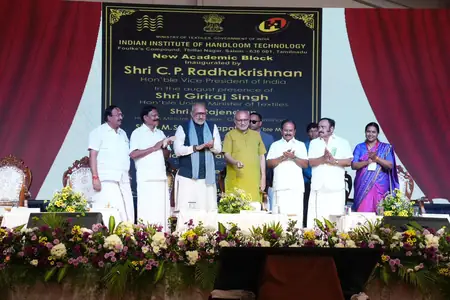
In a significant move for India’s handloom sector, Vice President C.P. Radhakrishnan inaugurated the new academic block at the Indian Institute of Handloom Technology (IIHT) in Salem, Tamil Nadu, on Friday. Speaking at the event, he emphasized the institute’s pivotal role in bridging traditional weaving crafts with modern technology, positioning them for global markets.
Salem, known for its rich historical and cultural tapestry, holds a special place in India’s freedom struggle. The Vice President highlighted its connection to national leader C. Rajagopalachari, who began his legal career here and served as chairman of the Salem Municipality. He also referenced the recent unveiling of Rajaji’s bust at Rashtrapati Bhavan, replacing the one of Edwin Lutyens.
IIHT Salem is at the forefront of revolutionizing handloom production by integrating age-old knowledge with cutting-edge textile science. This fusion enhances productivity, improves quality, and ensures handwoven fabrics meet contemporary demands while preserving their unique identity. The Vice President showcased India’s diverse handloom heritage, citing Varanasi’s silk brocades, Bengal’s Jamdani, Assam’s Muga silk, Kashmir’s Kani shawls, and iconic saris from Andhra Pradesh, Madhya Pradesh, and beyond.
Turning to Tamil Nadu’s weaving traditions, he praised Chettinad Kandangi saris, Kanchipuram silk, Arani silk, Thirubuvanam silk, Chenimalai blankets, Nagercoil veshthis, and Madurai Sungudi saris. These crafts not only embody cultural pride but also hold immense economic potential.
The Vice President underscored the upcoming India-EU Free Trade Agreement (FTA), which promises to elevate the textile industry’s global competitiveness. Under Prime Minister Narendra Modi’s leadership, focused government initiatives are paving the way for this growth. He expressed optimism about a surge in textile exports from Salem to the EU and leather exports from Ambur.
Urging IIHT Salem to transform the handloom sector into a future-ready creative industry, he called for value creation, respect for artisans’ labor, and sustainable employment for weavers nationwide. The event featured an exhibition of handloom products from across India, attended by Union Textile Minister Giriraj Singh, Tamil Nadu Tourism Minister R. Rajendran, and other dignitaries.
This inauguration marks a milestone in preserving India’s handloom heritage while propelling it towards modernity and international success. Institutions like IIHT are not just advancing technology but securing livelihoods for millions of artisan families.