
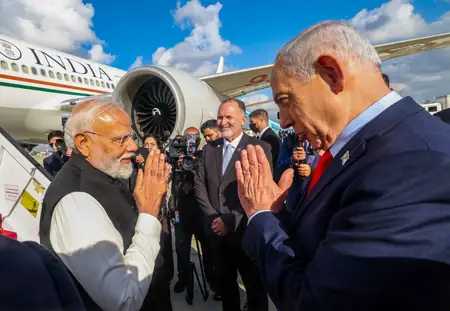
JERUSALEM – Prime Minister Narendra Modi’s two-day visit to Israel concluded on Thursday with a flurry of agreements that promise to redefine India-Israel ties. In a joint press conference with Israeli Prime Minister Benjamin Netanyahu, Modi greeted the audience with ‘Shalom’ and expressed heartfelt gratitude for the warm hospitality.
The centerpiece of the visit was high-level talks focusing on defense, security, trade, technology, and agriculture. Both leaders committed to elevating bilateral relations to new heights, particularly through enhanced regional connectivity projects like the India-Middle East-Europe Economic Corridor (IMEC) and the India-Israel-UAE-USA (I2U2) initiative.
A series of Memorandums of Understanding (MoUs) were signed, covering cutting-edge fields. One standout deal promotes cooperation in geophysical exploration, leveraging advanced AI and geophysical tech for mineral discovery, data sharing, and sustainable resource development.
Another agreement targets the National Maritime Heritage Complex (NMHC) in Lothal, Gujarat, fostering joint exhibitions, research, and expertise exchange to celebrate shared maritime legacies.
Cultural ties get a boost with a 2026-2029 exchange program featuring festivals, workshops, and artist residencies in music, theater, visual arts, and dance.
Financial innovation takes center stage with NPCI International and Israel’s Masaavi agreeing to implement Unified Payments Interface (UPI) for seamless cross-border remittances between the two nations.
In agriculture, the India-Israel Innovation Center for Agriculture (IINCA) will pioneer precision farming, satellite irrigation, advanced machinery, and pest management, alongside germplasm exchange and capacity building.
Further pacts include collaboration on horizon scanning for strategic foresight using AI, sustainable fisheries and aquaculture, financial services innovation via IFSCA and ISA, and labor mobility protocols in commerce, manufacturing, and hospitality sectors.
Education sees AI-driven advancements through an MoU emphasizing innovative teaching, teacher training, equitable access, and research sharing. Arbitration cooperation, CEO forum insights, Nalanda-Hebrew University exchanges, a cyber excellence center, and broader AI partnerships round out the achievements.
Additional announcements elevate the strategic partnership, upgrade science-tech forums to ministerial level, launch critical tech initiatives under NSA leadership, and set quotas for 50,000 Indian workers over five years. This visit marks a pivotal chapter in Indo-Israeli collaboration, blending innovation, security, and economic synergy for mutual prosperity.