
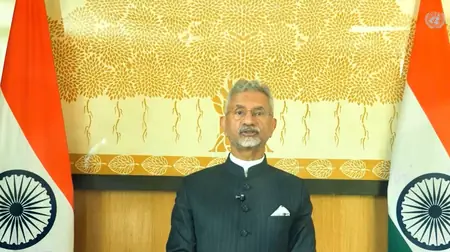
In a compelling address to the United Nations Human Rights Council in Geneva, India’s External Affairs Minister Dr. S. Jaishankar urged a shift from polarized debates to a comprehensive vision of human rights. Speaking via video conference on Wednesday, he emphasized development, capacity building, and real-world improvements for the most vulnerable, rather than politicization or double standards.
Jaishankar highlighted the need to confront terrorism head-on, calling it one of the gravest violations of human rights with no justification, especially when it targets innocent lives. ‘Terrorism is one of the biggest violations of human rights, and there can be no justification for it,’ he asserted.
Amid a world fraught with conflict, polarization, and uncertainty, India seeks common ground through dialogue, consensus, and human development over narrow interests. Jaishankar stressed that the UN and the Council must advocate zero tolerance for terrorist acts to truly honor their commitment to human rights.
India’s recent re-election to the Council for a seventh term with 177 out of 188 votes in the General Assembly reflects the international community’s trust, particularly from the Global South. ‘Our mandate reflects the confidence and expectations of the international community,’ he said, pledging to advance rights through dialogue and partnerships, not selective approaches.
Drawing from India’s experience as a developing democracy that has tackled poverty and external shocks while upholding pluralism and social justice, Jaishankar critiqued Western entities for underemphasizing certain global insecurities. He argued that insecurity in any region or isolation of any group ultimately undermines everyone’s rights.
On technology’s role, he positioned it as a ‘force multiplier’ for human rights, citing India’s Digital Public Infrastructure (DPI). This vast-scale investment has empowered millions with transparent access to welfare benefits, financial services, and public schemes, minimizing leakages. India is sharing this knowledge globally for public good.
Jaishankar warned that pandemics, climate change, and geopolitical tensions have exacerbated inequalities, underscoring the urgency for inclusive strategies. His vision promotes a holistic framework where human rights foster tangible progress for all.