
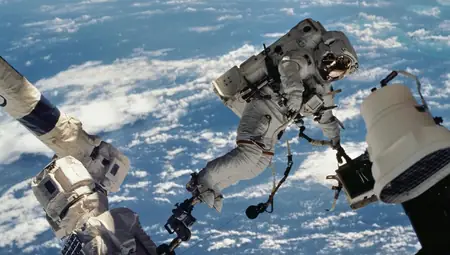
Ever wondered why your height isn’t constant throughout the day? Science reveals that gravity compresses our spine, shrinking us by 1-2 cm by evening. But in space, this effect reverses dramatically, making astronauts noticeably taller.
NASA data shows that in microgravity, astronauts’ height increases by up to 3% within the first few days. This expansion primarily occurs in the spinal column, where intervertebral discs, constantly compressed on Earth, decompress and swell.
On our planet, the relentless pull of gravity squeezes these fluid-filled discs, reducing our stature. Remove that force in orbit, and the spine elongates, altering posture, shoulder position, and overall body geometry.
Take astronaut Kate Rubins from Mission X: her Earth height of 171 cm stretched to 174.4 cm in space—a 3.4 cm gain. Upon returning to Earth, gravity quickly restored her original size.
Experts like NASA astronaut Mike Barrett and principal investigator Sudhakar Rajulu have detailed these changes in videos. They highlight how the body adapts—or struggles—in weightlessness.
To engage the public, NASA launched the ‘What’s Your Space Height?’ activity for students. Participants measure their morning height—when gravity’s daily toll is minimal—along with leg length and arm span. This introduces anthropometry, the science of human body measurements.
NASA’s anthropometrists use such data to design spacecraft, suits, seats, hatches, and the International Space Station. Height changes mean shoulders rise, hands lift farther from the floor, and reaching high becomes easier—but everything must be pre-sized accurately since mid-mission tweaks are impractical.
Astronauts secure themselves by wedging feet into floor stands during tasks. Spacecraft features are adjustable to accommodate pre-launch and post-return height differences, ensuring safety and efficiency in the final frontier.