
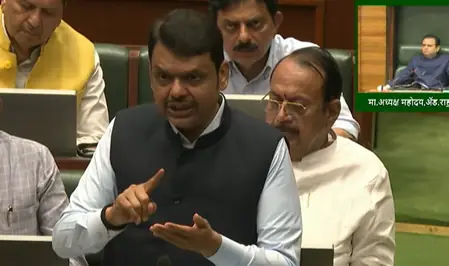
Mumbai’s legislative assembly witnessed a significant financial move on Tuesday as Chief Minister Devendra Fadnavis presented supplementary demands totaling ₹11,995 crore for the remaining period of the 2025-26 fiscal year. This comes amid mounting fiscal pressures on the state coffers, highlighting the government’s strategic spending priorities.
Of the total allocation, ₹3,112.85 crore has been earmarked to cover electricity bill waivers for agricultural pumps, power loom users, and textile consumers across Maharashtra. Another ₹803.94 crore is proposed under the incentive package scheme to bolster small, medium, and large industries, including mega projects that promise economic growth.
A major chunk, ₹4,792.02 crore, is designated for transferring loan funds received from the Asian Infrastructure Investment Bank (AIIB) to the state power distribution company, MSEDCL, for the solar agricultural pump scheme. This initiative aligns with the state’s net-zero mission, aiming to ramp up renewable energy usage to 52% by 2030.
The government also seeks ₹1,431.05 crore in additional central funding for implementing the Jal Jeevan Mission, ensuring better water access in rural areas. This follows a series of budget expansions: Ajit Pawar’s March 2025 budget projected a ₹45,890 crore revenue deficit, which escalated with June’s ₹57,509.71 crore supplementary demands, pushing the deficit beyond ₹1 lakh crore. By December’s winter session, another ₹75,286.37 crore in demands had swelled the revenue gap to over ₹2 lakh crore.
The 2025-26 budget had already forecasted Maharashtra’s debt burden rising to ₹9.32 lakh crore. Notably, Tuesday’s demands avoid new expenditures, focusing instead on farmer subsidies and industrial incentives—key to sustaining rural and economic vitality.
Looking ahead, CM Fadnavis is set to present the 2026-27 budget on March 6, with promises of stringent fiscal discipline measures announced during a recent press conference. At the World Economic Forum, he highlighted Maharashtra’s push towards 16 GW of solar power by year-end, with ambitions for an additional 45 GW by 2032, 70% from solar sources. Renewable energy share, at 13% four years ago, is projected to hit 52% by 2030.
Farmers now enjoy electricity supply costs dropping below ₹3 per unit from ₹8, easing burdens not just for agriculture but also industries and households. The state is also investing ₹24,631 crore in 5,630 MW pump storage hydropower projects, underscoring a balanced energy transition strategy.