
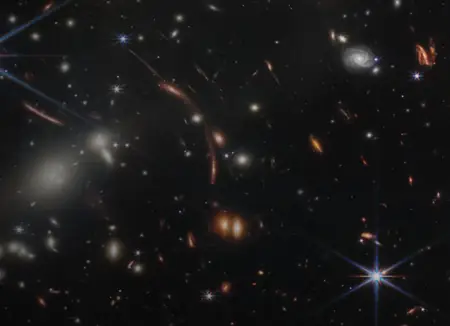
The cosmos holds countless enigmas, but few captivate scientists like dark energy, the invisible force driving the universe’s relentless expansion. According to NASA, this enigmatic power constitutes nearly 70% of the universe’s makeup, propelling galaxies farther apart at an ever-increasing pace.
Picture the Big Bang 13.8 billion years ago: a singularity of infinite density explodes, birthing space, time, and matter. The universe ballooned like an inflating balloon, cooling to form atoms, stars, galaxies, and planets. Early theories predicted gravity’s pull would eventually slow this growth, perhaps even reverse it into a ‘Big Crunch.’
Then came a shocking discovery in the late 1990s. Two teams studying Type Ia supernovae—stellar explosions with consistent brightness, ideal for measuring cosmic distances—used the Hubble Space Telescope. These ‘standard candles’ appeared fainter than expected, signaling their host galaxies were farther away. The only explanation? The universe’s expansion is accelerating, defying gravity’s grasp.
This repulsive force, dubbed dark energy, acts as anti-gravity, pushing space apart. In the universe’s infancy, matter dominated, slowing expansion via gravity. As galaxies spread out, gravity weakened, allowing dark energy to dominate. Today, telescopes like Hubble and James Webb probe deeper, seeking clues to its nature—perhaps a cosmological constant, quantum vacuum energy, or something revolutionary.
Unraveling dark energy could redefine reality, explaining not just our expanding home but the fate of everything. Will expansion continue forever, diluting stars to darkness, or turn inward? The quest continues, with missions like Euclid and DESI poised to illuminate the shadows.