
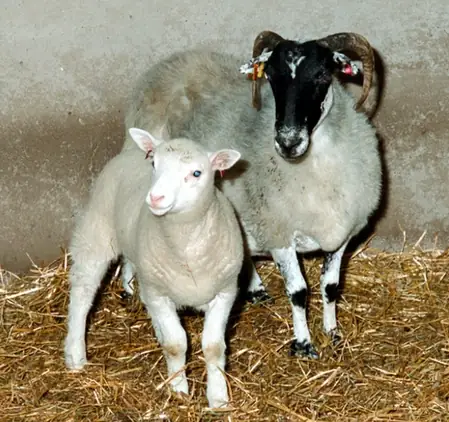
On a crisp day in July 1996, a lamb named Dolly entered the world in a quiet Scottish lab, forever altering the trajectory of biological science. Born at the Roslin Institute near Edinburgh, Dolly wasn’t just any sheep—she was the first mammal successfully cloned from an adult cell. This breakthrough, publicly announced on February 22, 1997, sent shockwaves through the scientific community and ignited global debates on ethics, medicine, and the very essence of life.
Led by biologist Ian Wilmut and his team, the project employed a groundbreaking technique called somatic cell nuclear transfer (SCNT). Scientists took a nucleus from a mammary gland cell of a six-year-old Finn Dorset ewe and inserted it into an enucleated egg cell from a Scottish Blackface ewe. After electrical stimulation to fuse the cells, the resulting embryo was implanted into a surrogate Blackface mother. Six months later, Dolly was born, genetically identical to the donor ewe.
What made Dolly revolutionary was her origin from a fully differentiated adult cell, challenging the long-held belief that such cells had lost their totipotency—the ability to develop into a complete organism. Dolly proved that with the right reprogramming, adult cells could be reset to an embryonic state, opening doors to stem cell research and regenerative medicine.
The announcement sparked jubilation among scientists envisioning cures for genetic diseases, organ shortages, and personalized therapies. Yet, it also unleashed fears of human cloning, designer babies, and playing God. Governments worldwide rushed to enact bans on reproductive cloning, while ethicists grappled with the implications for identity, humanity, and reproduction.
Dolly lived a monitored life under the spotlight, giving birth to six lambs naturally. Tragically, at age 6—a premature end compared to the typical 11-12 years for her breed—she was euthanized in 2003 due to progressive lung disease and arthritis. Post-mortem studies revealed telomeres shortened like her donor’s age, fueling discussions on cloning’s long-term viability. Despite her short life, Dolly’s legacy endures, paving the way for advancements in iPS cells, animal cloning for agriculture, and therapeutic cloning research that continues to push biomedical boundaries today.