
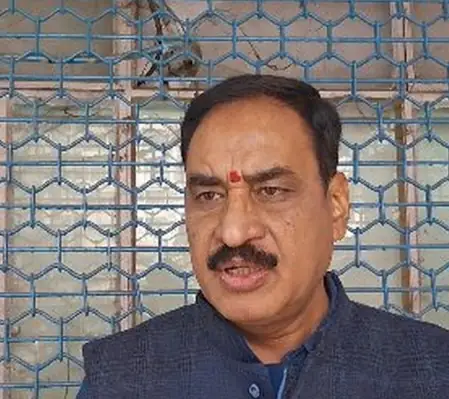
New Delhi witnessed a fiery political clash after Youth Congress activists disrupted the India AI Summit, drawing sharp condemnation from Vishwa Hindu Parishad national spokesperson Vinod Bansal. Labeling the protest as a blatant exposure of Congress’s ‘anti-India’ mindset, Bansal demanded an immediate apology from party leadership and invoked stringent measures like the National Security Act against the perpetrators.
In a strongly worded statement, Bansal highlighted how the demonstrators had unmasked the party’s true intentions. He criticized Congress leaders for glorifying the act by comparing it to revolutionary hero Bhagat Singh, calling it a deplorable distortion of history. ‘Opposing the government is one thing, but turning against the nation is a grave concern,’ he asserted, urging a crackdown on such elements.
Bansal didn’t stop at the summit fiasco. He took aim at Congress’s historical stance on infiltration, branding it a ‘chronic disease’ that has eroded India’s fabric like termites. Pointing to border regions in the Northeast and West Bengal, he accused unchecked influx from Bangladesh of altering demographics and cultural identities in states like Assam. ‘Whenever this issue is raised, a so-called jihadist alliance rises in opposition,’ he charged, praising the central government’s resolve to detect, delete, and deport such intruders.
Meanwhile, Congress MP Pramod Tiwari fired back on a separate front, decrying the India-US trade deal as exploitative. Citing American tariffs as a one-sided imposition, he alleged that the US was capitalizing on Prime Minister Narendra Modi’s ‘weakness.’ Referencing former President Donald Trump’s remarks, Tiwari warned that threats over tariffs could undermine India’s strategic interests, including operations against Pakistan. He emphasized the plight of Indian farmers, who operate on small landholdings compared to their American counterparts, arguing that fair competition is impossible and could devastate the agrarian economy.
As political rhetoric intensifies, these exchanges underscore deepening divides on national security, technology advancement, and global trade, with both sides digging in for a prolonged battle.