
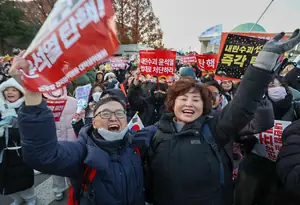
SEOUL – Political turmoil engulfs South Korea following the court’s decision to sentence former President Yoon Suk Yeol to life imprisonment instead of the death penalty for his failed attempt to declare martial law in December 2024. Protests erupted outside the courthouse as crowds who had gathered in anticipation of capital punishment vented their fury over what they see as leniency.
On Thursday, February 19, the court branded Yoon a rebel and handed down the maximum non-capital sentence available under South Korean law for insurrection. Supporters of harsher justice cheered briefly before disappointment set in. Since 1997, no executions have taken place in the country, creating an effective moratorium on the death penalty despite its legal existence.
Opposition leaders and civic groups wasted no time condemning the verdict. Democratic Party of Korea chief Jung Chung-rae called it a betrayal of the citizen movements that thwarted Yoon’s martial law bid. ‘This is a clear retreat from the people’s will,’ he declared. Labor unions, human rights organizations, and street protesters echoed the sentiment, accusing Yoon of abusing power to undermine democratic institutions by mobilizing the military during a political crisis.
Yoon’s presidency ended amid allegations of overreach, including invoking emergency powers reminiscent of past authoritarian eras. Critics argue that leaders who threaten democracy deserve the ultimate punishment to deter future abuses. Yet, courts have consistently opted for life terms in politically charged cases, as seen with former military dictator Chun Doo-hwan, whose death sentence for a 1979 coup and the Gwangju massacre was commuted to life, then pardoned in 1997.
Legal experts note South Korea’s criminal code limits rebellion penalties to death, hard labor life imprisonment, or life imprisonment. Yoon received the latter with hard labor, eligible for parole after 20 years. Prosecutors had pushed for death, arguing it sends an unequivocal message without parole loopholes. However, defense lawyers framed capital punishment as symbolic community retribution rather than literal execution.
The divide runs deep in South Korean society. One side demands retribution to safeguard democracy; the other prioritizes judicial restraint and human rights in a polarized political landscape. As debates rage, the sentence underscores the tension between vengeance and measured justice in a nation still healing from its authoritarian past.