
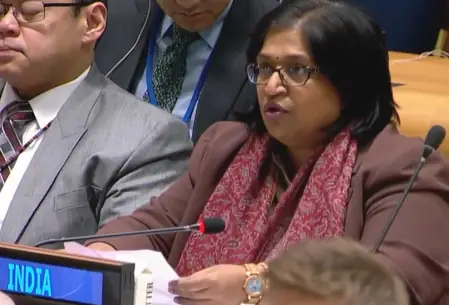
In a firm stand at the United Nations, India has outright rejected the proposal for a third category of membership in the Security Council. Described as a delaying tactic, this category promises longer terms and renewability but falls short of true reform without expanding permanent seats.
India’s Deputy Permanent Representative, Yojana Patel, addressed the Intergovernmental Negotiations (IGN) meeting on Friday, labeling the idea as a ploy to perpetuate the UN’s legitimacy crisis for decades. ‘Considering a third category is merely intended to further delay the process, derail the direction of reform entirely, or deliberately offer an incomplete package that postpones real reform for many decades, damaging the UN’s legitimacy, credibility, and relevance,’ she stated.
The proposal, dubbed ‘fixed regional seats,’ originates from a small group of countries opposed to permanent membership expansion. Led by nations like Italy and Pakistan in the Uniting for Consensus (UfC) group, they have consistently blocked progress through procedural maneuvers, preventing adoption of negotiation texts.
Patel emphasized broad support for reform, noting, ‘Apart from a few self-serving member states, the overwhelming majority agree that Security Council reform is not a matter of tomorrow, but yesterday.’
Speaking on behalf of the G4 alliance—which includes India, Japan, Germany, and Brazil—Japan’s Permanent Representative Kazuyuki Yamazaki clarified that these seats differ little from existing non-permanent ones. ‘Since continuity of membership in this proposed category is not assured, it cannot substitute for permanent seats and does not address the structural imbalances in the Council,’ he said.
The G4 advocates strongly for expanding both permanent and non-permanent categories, with mutual support among members for permanent seats.
Another reform-supporting bloc, L.69—which includes India and 41 other developing nations—echoed these sentiments. Saint Lucia’s Permanent Representative Menissa Rambally, speaking for the group, expressed concern over any intermediate or hybrid proposals replacing the two traditional categories. ‘This would not be real reform for the Council, and the Global South has not waited 80 years to accept a hybrid formula merely as a consolation or facade of reform,’ she asserted.
Patel also dismissed suggestions to grant veto powers to fixed regional seat holders, calling it a vague idea designed to complicate discussions and bolster opposition to permanent expansion.
She reiterated that true reform requires enlarging both permanent and non-permanent categories, a position backed by most UN members. Reforms without permanent expansion would be incomplete and unjust, ignoring the aspirations of key groups.
Addressing concerns that more permanent members would complicate operations, Patel countered that working methods can be reviewed and updated to accommodate an enlarged Council representing Asia-Pacific, Africa, and Latin America-Caribbean more equitably.
India’s stance underscores the urgent need for a Security Council that reflects today’s global realities, pushing back against half-measures that sustain outdated power structures.