
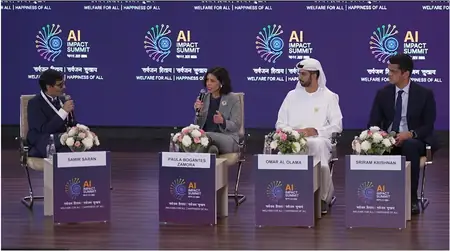
New Delhi buzzed with intellectual fervor as the India AI Impact Summit 2026 hosted a powerhouse panel discussion on the future of artificial intelligence. World-renowned leaders delved deep into national strategies for AI proliferation, infrastructure needs, innovation drivers, and the evolving frameworks for global collaboration and regulation.
The session featured Costa Rica’s Minister of Science, Innovation, Technology, and Telecommunications, Paula Bogantes Zamora; UAE’s Minister of State for Artificial Intelligence, Digital Economy, and Remote Work Applications, Omar Al Olama; White House Senior Policy Advisor for AI, Ram Krishnan; and Dr. Samir Saran, President of the Observer Research Foundation.
Ram Krishnan kicked off by outlining the United States’ AI priorities, built on three pillars: developing world-class AI infrastructure, fostering innovation, and strengthening partnerships with allied nations. He stressed the critical expansion of data center capacity and computing power, emphasizing affordability and energy sustainability. ‘Innovation must not be stifled by excessive bureaucracy,’ Krishnan asserted, calling for regulatory clarity and predictability to empower innovators while safeguarding child protection, intellectual property, and national security.
He highlighted the role of international partnerships in advancing shared AI capabilities, secure supply chains, and technology cooperation. Turning to the UAE’s vision, Omar Al Olama positioned AI as a tool for enhancing quality of life and delivering broad societal benefits. As the world’s first AI Minister, he shared insights on infrastructure readiness, AI literacy, and responsible deployment to ensure AI reaches every segment of society.
Al Olama advocated for continuous dialogue through global forums, inclusive governance, and adaptive regulatory frameworks that evolve with technology. He warned against sudden regulatory overhauls, pushing for progressive, consultative approaches that balance innovation with safety, ensuring no nation is left out of global AI conversations.
Paula Bogantes Zamora brought the perspective of small and developing economies, urging honest assessments of digital readiness. She pointed to fundamentals like connectivity via 5G, national AI strategies, data governance, and investments in R&D. Addressing disparities in innovation spending and digital infrastructure, she called for regulations tailored to each country’s development stage.
Zamora emphasized regional cooperation and like-minded groups to amplify voices and bargaining power. Declaring data as a key asset, she demanded global discussions on equitable access to AI tools and support mechanisms to build foundational capacities before scaling advanced solutions.
Moderated by Dr. Samir Saran, the discussion centered on impact, proliferation, and multilateralism. Saran underscored balancing innovation with restraint, addressing security, guidelines, and human-centered design. The panel explored how regional, thematic, or values-based partnerships can ensure inclusive and responsive AI governance in a rapidly evolving tech landscape.
The session concluded with consensus: AI offers transformative opportunities for economic growth, social progress, and improved quality of life. Investments in infrastructure, innovation promotion, responsible regulation, and expanded global collaboration will be key to maximizing benefits for humanity. The India AI Impact Summit 2026 reaffirms its role as a premier global platform shaping secure, inclusive, and future-proof AI governance.