
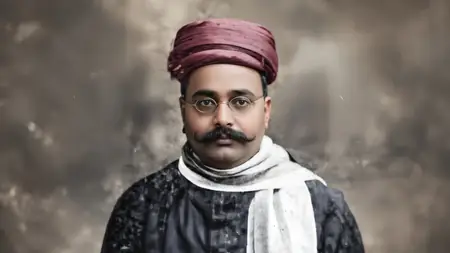
In the annals of India’s freedom struggle, few figures command as much respect as Gopal Krishna Gokhale. Born on May 9, 1866, in Ratnagiri, Maharashtra, Gokhale was not just a mathematician and professor but a master strategist who wielded statistics like a weapon against colonial rule. His precision in debates left British viceroys squirming, with even the haughty Lord Curzon acknowledging his intellectual prowess.
When a young Mohandas Gandhi returned from South Africa in January 1915, brimming with energy but short on local insight, it was Gokhale who became his guiding light. ‘Keep your eyes open and your mouth shut for a year,’ Gokhale advised, instilling in Gandhi the patience needed to truly understand India’s complexities. Without this mentorship, the world might never have witnessed the rise of Mahatma Gandhi.
Gokhale’s prowess shone brightest in the Imperial Legislative Council. Armed not with swords but data sheets, he dismantled colonial policies. He exposed the crippling salt tax that robbed the poor of basic sustenance, challenged exorbitant military spending, and demanded funds be redirected to education. His arguments were irrefutable, forcing British officials into uncomfortable silences.
A firm believer that politics was a lifelong penance, Gokhale founded the Servants of India Society in 1905. This wasn’t a political party but a rigorous order for patriots. Members took seven vows, pledging lifelong poverty, selfless service, and no personal wealth accumulation. Gokhale cultivated a generation committed to quiet service over fleeting fame.
Even Mohammad Ali Jinnah, later Pakistan’s founder, idolized him. Jinnah once declared his ambition to become a ‘Muslim Gokhale,’ praising Gokhale’s unwavering commitment to Hindu-Muslim unity. Gokhale reciprocated, calling Jinnah the finest ambassador of communal harmony. Such was his charisma that rivals like Bal Gangadhar Tilak mourned his death as the loss of India’s ‘diamond.’
In his final days, Gokhale toiled to unite Congress’s moderate and extremist factions. His ‘Political Testament’ outlined a blueprint for self-governance, influencing the 1919 reforms and India’s Constitution. Gokhale passed on February 15, 1915, just a month after Gandhi’s return—a poignant twist of fate underscoring his enduring legacy in shaping modern India.