
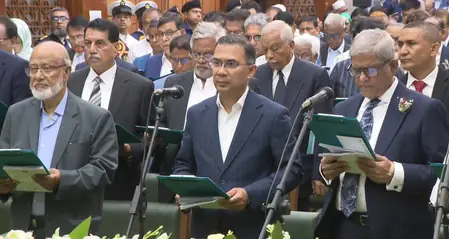
Dhaka erupted in political fervor on Tuesday as newly elected Bangladesh Nationalist Party (BNP) lawmakers from the 13th parliamentary elections took their oaths at the National Parliament’s South Plaza. In a bold move, these MPs deliberately avoided swearing in as members of the Constitution Reform Council, delivering a significant setback to Chief Adviser Muhammad Yunus.
Chief Election Commissioner AMM Nasir Uddin administered the oaths in line with the country’s constitution, stepping in due to the vacancy of the Speaker and Deputy Speaker positions from the previous parliament. Parliament Secretariat Secretary Kaniz Mula oversaw the ceremony, marking a pivotal moment in Bangladesh’s post-election landscape.
BNP Chairperson Tarique Rahman, elected from Dhaka-17, led by example, taking the oath solely as an MP. His wife, Zubaida Rahman, and daughter, Jaida Rahman, were present to witness the historic event. This decision underscores the party’s firm stance against the reform council, which was proposed by Yunus’s interim government and 30 political parties following the ouster of Sheikh Hasina’s regime in 2024. The plan, unveiled in July 2025, aimed at sweeping constitutional, electoral, and administrative overhauls.
BNP leader Salahuddin Ahmed revealed that Tarique Rahman instructed all party MPs to reject the reform council form, emphasizing they were not elected to that body. Meanwhile, alliances led by Jamaat-e-Islami and National Citizen Party (NCP) contemplated boycotting the oaths but ultimately participated, with Jamaat MPs swearing in at the venue.
The elections, held alongside a referendum on the National Charter on February 12, saw voting across 299 of 300 constituencies. BNP dominated with 209 seats, propelling their alliance to victory in 212 areas. Jamaat-e-Islami secured 68 seats, leading their coalition to 77 wins. Smaller parties like NCP (6 seats), independents (7), Bangladesh Khilafat Majlish (2), Islamic Movement Bangladesh (1), Bangladesh Jatiya Party (1), Gonoadhikar Parishad (1), Ganasanghati Andolan (1), and Khilafat Majlish (1) also clinched victories.
This oath-taking ceremony signals deepening political divides, with BNP asserting its mandate and challenging the interim government’s reform agenda head-on. As the new parliament convenes, Bangladesh braces for intense debates on its constitutional future.