
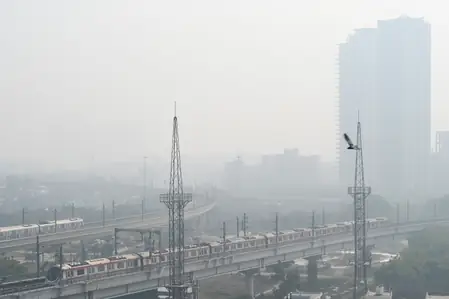
Noida, February 17: The National Capital Region (NCR) is grappling with severe air pollution once again as wind speeds have dropped dramatically, pushing the Air Quality Index (AQI) into the dreaded red zone. Delhi, Noida, and Ghaziabad are bearing the brunt, with most areas recording ‘severe’ pollution levels that pose immediate health risks to residents.
Monitoring stations across Delhi paint a grim picture. Anand Vihar clocked an AQI of 319, Ashok Vihar at 337, Bawana 321, Burari Crossing 345, and Chandni Chowk 302—all firmly in the red category indicating hazardous air. Some spots like Alipur (242), DTU (271), and Dwarka Sector-8 (234) fall into the orange ‘very poor’ range, while Ayanagar (158) and CRRI Mathura Road (189) are in yellow ‘moderate’ territory. This stark variation underscores how stagnant air traps pollutants, exacerbating the crisis.
In Noida, Sector-125 reported 286, Sector-62 223, Sector-1 234, and Sector-116 232, mostly orange but worrisome nonetheless. Ghaziabad fares worse: Indirapuram at 324, Vasundhara 301, and Sanjay Nagar 251, with the first two in red.
Relief might be on the horizon, though. The India Meteorological Department (IMD) predicts rain and gusty winds up to 40 km/h on February 18, starting in the morning with thunderstorms and lightning. Maximum temperatures will dip to 27°C from today’s 30°C, with minimums around 13-14°C. Post-rain, clearer skies are expected from February 19-21, potentially dispersing the toxic haze and improving AQI.
Experts warn that calm winds have allowed PM2.5 and other particulates to accumulate, urging residents to limit outdoor activities, use masks, and stay indoors. Authorities may soon enforce stricter measures like construction bans if levels don’t improve. As NCR chokes, the forecast offers a glimmer of hope amid the smog.