
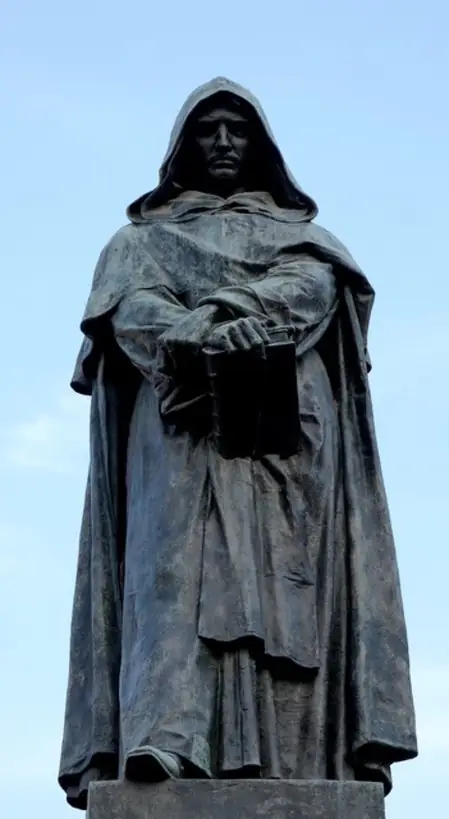
In the heart of Renaissance Europe, one man’s relentless pursuit of truth clashed violently with the iron grip of religious authority. Giordano Bruno, the Italian philosopher, mathematician, and astronomer born in 1548 in Nola, Italy, became an enduring symbol of free thought. His ideas shook the foundations of 16th-century dogma, leading to his brutal execution by fire in Rome’s Campo de’ Fiori on February 17, 1600.
Bruno’s early life took him from local schools to the Dominican monastery, where he immersed himself in theology and philosophy. But doubts soon crept in. Influenced by Nicolaus Copernicus’s heliocentric model, which dethroned Earth from the universe’s center, Bruno pushed boundaries further. He proclaimed the universe infinite, teeming with countless stars, each potentially hosting its own solar system. He even speculated about life on other planets—a radical notion in an era when the cosmos was viewed as finite and Earth-centric.
These astronomical heresies were just the beginning. Bruno’s pantheistic philosophy equated God with the infinite universe itself, insisting that truth emerges from reason and observation, not blind faith. The Catholic Church, guarding its doctrines fiercely, saw this as a direct assault. Arrested in 1592 in Venice, Bruno endured eight years of Inquisition trials in Rome. Tortured and coerced, he refused to recant. His defiance sealed his fate.
Today, Bruno stands as a martyr for scientific inquiry and intellectual freedom. In a poetic twist of history, a statue erected in 1889 now graces the very square where he burned, reminding passersby of the cost of challenging power. Bruno’s legacy endures, inspiring generations to question, explore, and expand the horizons of human knowledge.