
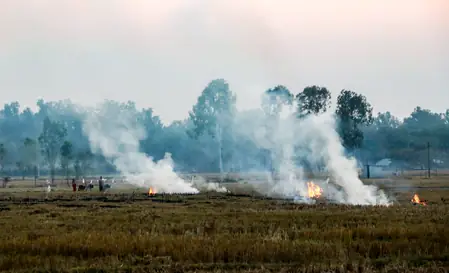
In a decisive move to combat air pollution in India’s national capital region, the Commission for Air Quality Management (CAQM) has issued a binding directive to Punjab, Haryana, and Uttar Pradesh. The order mandates these states to fully eliminate wheat stubble burning during the 2026 harvest season through meticulously planned and coordinated state-level action plans.
Stubble burning has long been a major culprit behind the hazardous air quality spikes in Delhi and surrounding areas every winter. The CAQM emphasized that agricultural residue burning not only degrades local air but also severely impacts the entire National Capital Region (NCR) and beyond. Recent data from ISRO/ARI protocols revealed multiple fire incidents in NCR districts of these states during the 2025 wheat harvest from April 1 to May 31.
Building on earlier guidelines, the CAQM had urged states to craft tailored action plans. In its 26th meeting on December 22, 2025, and subsequent discussions with state representatives, the commission reviewed submissions and recommended enhancements. Now, implementation is non-negotiable.
Key directives include mapping every farm in every village and classifying them based on management strategies like crop diversification, in-situ or ex-situ handling, or use as fodder. Each district must appoint nodal officers to monitor up to 100 farmers. Mobile apps will facilitate timely access to Crop Residue Management (CRM) machines, with free provision for small and marginal farmers.
States are also tasked with ensuring ample storage facilities, establishing supply chains for ex-situ uses, and forming ‘Stubble Protection Forces’ at district and block levels involving police, agriculture, and administration. Enhanced evening patrols, environmental compensation mechanisms, and widespread awareness campaigns on hazards and best practices are additional mandates.
Delhi and Rajasthan have been advised to intensify efforts similarly. Monthly progress reports to CAQM will ensure accountability, marking a structured push towards cleaner air by 2026.