
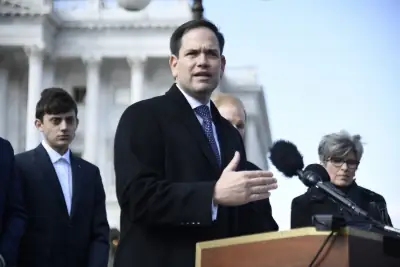
In a high-profile visit to Budapest, US Secretary of State Marco Rubio signed a landmark civil-nuclear cooperation agreement with Hungary’s Foreign Minister, spotlighting the strengthening ties under President Donald Trump’s influence. During a joint press conference with Prime Minister Viktor Orban, Rubio deftly highlighted how the US granted Hungary a one-year exemption from sanctions on Russian oil and gas last year, crediting the personal rapport between Trump and Orban.
‘This was due to that personal relationship,’ Rubio stated emphatically. ‘We want your economy to thrive, your country to succeed. It’s in our interest, especially as long as you and your leadership are at the helm.’ This gesture underscored America’s strategic support for allies navigating complex energy dependencies amid Russia’s invasion of Ukraine in 2022, where Hungary maintained its reliance on Russian supplies despite criticism from EU and NATO partners.
Rubio’s remarks subtly contrasted US flexibility with Western allies’ reluctance, positioning America as a pragmatic partner. Addressing queries on Iran and China, he dismissed isolationism as folly. ‘We’re not telling any country to cut ties with others,’ he said on China. ‘We understand geography, economy, history, and challenges. But we share concerns with partners.’ He announced an upcoming presidential trip to China in April, emphasizing dialogue with the world’s second-largest economy, home to over a billion people and nuclear capabilities.
‘Differences exist, but they can be managed,’ Rubio added, praising Trump’s deal-making prowess. Orban, in turn, lauded 17 US investments in Hungary during Trump’s tenure, hailing the era as the dawn of a golden age in bilateral relations. Rubio echoed this optimism, vowing US efforts for global peace, including unique mediation potential in the Russia-Ukraine conflict and cautious engagement with Iran, described as a ‘hardline religious state’ yet worth pursuing.
The agreements and rhetoric signal a renewed US-Hungary alliance, prioritizing economic stability and diplomatic realism over rigid sanctions.