
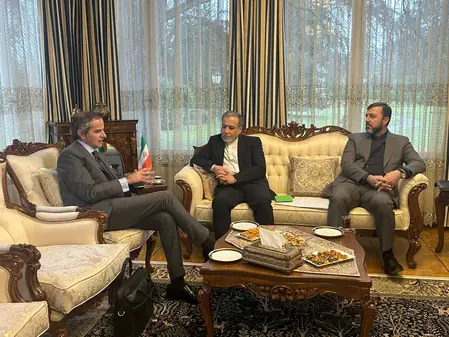
In a crucial prelude to the second round of high-stakes negotiations between the United States and Iran, Iran’s Foreign Minister Abbas Araghchi arrived in Geneva and promptly held talks with International Atomic Energy Agency (IAEA) Director General Rafael Grossi. Grossi himself confirmed the meeting, sharing photos on social media with the caption: ‘Just wrapped up in-depth technical discussions with Iran’s Foreign Minister Araghchi ahead of essential talks in Geneva.’
Araghchi had signaled the encounter on X beforehand, stating he would engage in detailed technical discussions with Grossi on Monday, followed by a meeting with Oman’s Foreign Minister Badr al-Busaidi before Tuesday’s diplomacy with the US. ‘I’m in Geneva with real ideas for a right and equal deal,’ he affirmed.
The IAEA has been pressing Iran for months to account for 440 kilograms of highly enriched uranium missing after June’s Israeli-US strikes. The agency demands full inspections resume, particularly at bombed sites Natanz, Fordow, and Isfahan.
Iran’s Deputy Foreign Minister Majid Takht-Ravanchi urged the US to demonstrate seriousness in reaching a deal with Tehran, warning that war would harm everyone. In an interview, he noted recent indirect talks in Oman show Washington’s interest in peaceful resolution. ‘The ball is in America’s court to prove it wants a deal. If honest, we’ll be on the path to agreement,’ he said.
The White House confirmed Saturday that Middle East envoy Steve Witkoff and Jared Kushner, President Trump’s son-in-law, are dispatched for the talks. Secretary of State Marco Rubio echoed Trump’s preference for diplomacy first, but all options remain open.
Iran insists its nuclear program is peaceful, yet enriches uranium to 60% purity—perilously close to weapons-grade. The Trump administration vows no enrichment allowances under any circumstances. On Friday, Trump announced deploying the world’s largest aircraft carrier, USS Gerald R. Ford, from the Caribbean to the Middle East, repeatedly touting regime change in Iran as the ideal outcome.
As tensions simmer, these Geneva meetings could pivot the region toward de-escalation or deeper conflict. Stakeholders watch closely for signs of breakthrough amid military posturing.