
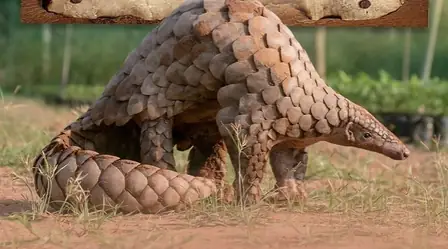
Deep within India’s lush forests, rolling hills, and arid plains roams a creature straight out of a fairy tale – the Indian pangolin. Often called nature’s quiet sentinel, this shy mammal stands out with its unique armor of overlapping keratin scales, making it the only scaled mammal on Earth. These brownish scales, blending seamlessly with the soil, number between 160 and 200, forming an unbreakable fortress.
When danger lurks – be it a prowling lion or a stealthy tiger – the pangolin instinctively curls into a tight ball. This defensive posture renders its tough shell impervious, leaving even the fiercest predators frustrated and empty-handed. Measuring 84 to 122 centimeters from head to tail, with a robust tail adding another 33 to 47 centimeters, it weighs between 10 and 20 kilograms. Nocturnal by nature, it spends days hidden in burrows, emerging at night to forage in solitude.
Favoring areas rich in ant hills, termite mounds, bushes, and tree roots, the pangolin shuns climbing trees. Its most astonishing feature is a tongue longer than its body – up to 40 centimeters or more when fully extended. Anchored near the pelvis and last ribs, this sticky appendage delves into deep crevices, ensnaring ants, termites, their eggs, larvae, and even occasional beetles or cockroaches. Strong front claws rip open mounds, allowing its tongue to harvest thousands of insects nightly.
This insectivorous diet plays a pivotal role in ecological balance. By devouring millions of pests, the pangolin protects crops and forests from devastation. Its digging habits aerate soil, enhancing water infiltration and nutrient flow. Yet, tragedy shadows this vital species. Classified as endangered by the IUCN Red List and Schedule I of India’s Wildlife Protection Act, the Indian pangolin faces existential threats.
Poaching and international trafficking of its scales for traditional medicines and jewelry drive its decline. Conservation groups, partnering with forest departments in states like Madhya Pradesh, conduct vital research on its ecology, distribution, and habitat use. These efforts aim to craft robust strategies preserving this enigmatic guardian. As awareness grows, hope flickers that the pangolin’s silent watch over India’s wilds will endure.