
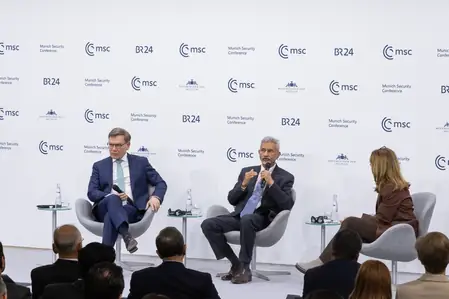
In a firm rebuttal at the Munich Security Conference, India’s External Affairs Minister S. Jaishankar dismissed American assertions that New Delhi has pledged to stop purchasing additional crude oil from Russia. Speaking on Saturday, Jaishankar emphasized India’s unwavering commitment to strategic autonomy, a cornerstone of its foreign policy shaped by history and national development.
The remarks come amid heightened tensions in global energy markets, exacerbated by fresh US sanctions on Russian energy exports. US Secretary of State Marco Rubio and President Donald Trump have repeatedly claimed that India agreed to curb extra Russian oil imports as part of a recent interim trade deal between the two nations. Rubio specifically stated that Washington received assurances from India to refrain from further purchases, aligning with Europe’s moves to reduce reliance on Russian supplies.
Jaishankar, however, painted a nuanced picture of the global oil landscape. ‘Energy decisions are made by considering availability, price, and risk,’ he said, highlighting how Indian oil companies, much like their counterparts worldwide, prioritize practical benefits. He rejected any notion that the trade agreement undermines India’s independent decision-making framework.
When pressed directly on whether India would halt Russian oil imports under the deal’s terms, Jaishankar responded unequivocally: ‘If your question means will I think independently, make my own decisions, and possibly ones that don’t align with yours—yes, that’s possible.’
This stance underscores India’s pragmatic approach to energy security. As the world’s third-largest oil importer, New Delhi has diversified its sources to mitigate risks, including discounted Russian crude amid the Ukraine conflict. Neither confirming nor denying US claims officially, India continues to navigate superpower pressures while safeguarding its interests.
Jaishankar’s comments resonate beyond energy, reaffirming India’s multipolar worldview. Strategic autonomy isn’t just policy—it’s ingrained in the nation’s ethos, ensuring decisions serve India’s growth trajectory without external dictation. As geopolitical fault lines deepen, New Delhi’s position signals a balanced path forward in turbulent times.