
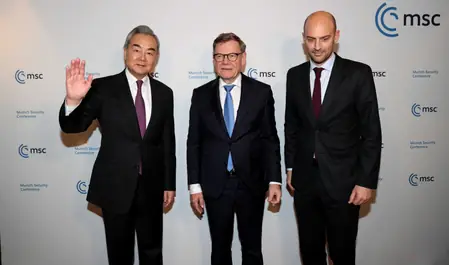
In a significant diplomatic move amid global uncertainties, Chinese Foreign Minister Wang Yi convened the first-ever trilateral meeting with his German counterpart Annalena Baerbock and French Foreign Minister Jean-Noël Barrot on the sidelines of the Munich Security Conference. The gathering, held on February 14, underscores a fresh approach to strategic communication between these major powers.
Wang Yi highlighted the meeting as an innovative response to the world’s most profound changes since World War II. With peace and development facing unprecedented challenges, he stressed the responsibilities of China, Germany, and France as key economies and influential nations. ‘We must adhere to mutual respect, seek common ground while reserving differences, advocate open cooperation, and promote win-win partnerships,’ Wang said, aiming to steer China-EU relations positively and inject stability into the volatile international landscape.
Emphasizing five decades of fruitful exchanges, Wang asserted that China and the EU are partners, not adversaries. China’s growth presents opportunities for Europe, not threats, and Europe’s challenges do not stem from Beijing. He urged Germany and France, as EU heavyweights, to align their actions with broader EU interests, fostering a rational China policy and upholding the EU-China partnership.
German Foreign Minister Annalena Baerbock echoed the need for enhanced dialogue in turbulent times. ‘Germany values China’s constructive role in global affairs and is eager to strengthen communication,’ she stated, reaffirming commitment to the one-China policy and stable ties. Both European ministers supported free trade, opposed decoupling, and expressed readiness to resolve trade frictions for balanced EU-China economic relations.
France’s Jean-Noël Barrot warned of rising global instability threatening multilateralism. He called for joint efforts to promote peace, reform global governance, and revive stable EU-China ties. Welcoming President Xi Jinping’s global governance initiatives, Barrot stressed the potential for parallel advancement of bilateral and EU-China relations without conflict, advocating stronger coordination on multilateral platforms to safeguard multilateralism and free trade.
This trilateral format signals a commitment to constructive engagement, potentially paving the way for more coordinated responses to pressing global issues.