
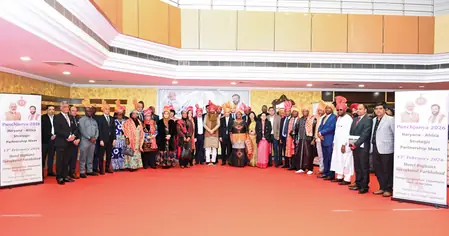
In a landmark gathering at the culturally vibrant Surajkund, Haryana Chief Minister Nayab Singh Saini declared the dawn of a new era in India-Africa partnerships. Addressing ambassadors and high commissioners from 21 African nations on Friday, Saini emphasized deepening economic collaboration across multiple sectors.
The Haryana-Africa Strategic Partnership meeting, held amidst the ongoing Surajkund International Crafts Mela, delved into opportunities in industry, trade, investment, and technology. Saini highlighted how this iconic fair serves as a global platform blending local traditions, handicrafts, creativity, and human ingenuity to foster cultural bonds and economic ties.
‘India-Africa relations are rooted in equality, mutual respect, and shared prosperity,’ Saini stated, aligning his vision with Prime Minister Narendra Modi’s directives. Haryana, he noted, is the first state to establish a dedicated Foreign Cooperation Department to propel international partnerships.
Positioning Haryana as a growth engine in agriculture, manufacturing, MSMEs, food processing, auto components, and startups, Saini pointed to its strategic NCR connectivity offering global linkages and robust logistics. This setup opens vast avenues for multi-sectoral cooperation with African countries.
Agriculture emerged as a cornerstone, with Haryana’s expertise in irrigation, advanced seeds, crop diversification, mechanization, dairy, and post-harvest management poised to bolster food security in Africa. Saini spotlighted potential joint farming ventures, training programs, and tech partnerships with Kenya, Tanzania, Uganda, Ethiopia, and Rwanda.
Memorandums of understanding with Tanzania Investment Centre and other bodies are set to enhance trade, investment, and agricultural collaboration. Beyond farming, prospects abound in automobiles, healthcare, IT, construction, skill development, startups, and MSMEs.
Saini stressed shared responsibilities in renewable energy, water conservation, and green development. Joint initiatives in solar power, water management, and environmental protection are vital for securing future generations.
Industry and Commerce Minister Rao Narbir Singh echoed the sentiment, calling this a pivotal moment to strengthen India-Africa trade, now nearing $90-100 billion annually. India imports crude oil, gold, coal, fertilizers, and minerals from Africa, while exporting petroleum products, pharmaceuticals, automobiles, machinery, rice, and engineering goods.
These ties extend beyond commodities into education, health, IT, and capacity building, promising a brighter, collaborative future for both regions.