
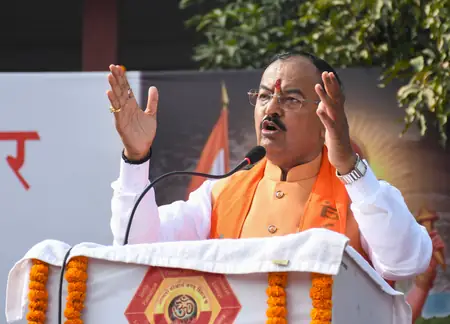
New Delhi is buzzing with political fervor as the central government’s new guidelines mandating ‘Vande Mataram’ spark nationwide debate. Uttar Pradesh Deputy Chief Minister Keshav Prasad Maurya has thrown down the gauntlet, declaring that anyone wishing to live in India must sing the national song. ‘No one will be able to oppose Vande Mataram,’ he asserted. ‘If you want to stay in India, singing it is compulsory. Those who oppose it will reveal their true colors.’
The controversy erupted following the Home Ministry’s directive to fully implement the singing of the complete version of ‘Vande Mataram,’ coinciding with its 150th anniversary this year. BJP leaders have rallied behind the move, emphasizing its historical significance as the theme song of India’s freedom struggle.
Congress MP Imran Masood from Delhi voiced strong dissent, questioning how the government could dictate personal faith. ‘You sing Vande Mataram, and we’ll stand up,’ he said. ‘But don’t expect me to change my worship. The Constitution allows me this freedom.’
Mumbai’s Deputy Mayor Sanjay Ghadi struck a balanced tone, urging citizens to follow laws but stressing that no directive should target any religion. ‘We must respect each other’s faiths,’ he added.
BJP MP Mayankbhai Nayak highlighted opposition from certain quarters who threatened Supreme Court action when the full song was proposed. Sakshi Maharaj, another BJP MP, clarified that ‘Vande Mataram’ honors the motherland, not any deity, making it essential for true patriots.
Shiv Sena spokesperson Shaina NC echoed the sentiment, calling it a matter of national pride. ‘If you live in India, sing Vande Mataram. If you don’t know it, learn it,’ she urged, distinguishing it from the national anthem ‘Jana Gana Mana.’
BJP spokesperson Pratul Shah Dev dismissed protests from Jamiat Ulema-e-Hind, noting the Home Ministry’s firm implementation. Legislators like Vivekanand Pandey, Yogesh Shukla, Nand Kishor Gurjar, and Rajeshwar Singh reinforced that opposing the song undermines national sovereignty and patriotism. Gurjar even suggested opponents consider moving to Pakistan.
As the debate rages, the guidelines underscore a push for unified national expression, testing the boundaries of patriotism, faith, and constitutional rights in modern India.