
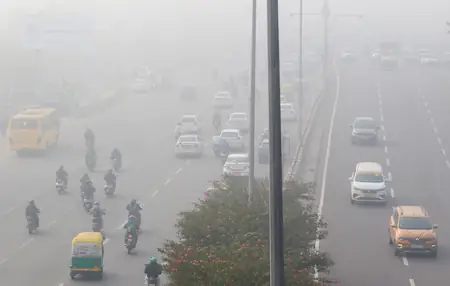
New Delhi’s air quality has taken a sharp turn for the worse after just two days of partial improvement. The Air Quality Index (AQI) across the National Capital Region (NCR) has surged back into the ‘severe’ red zone in multiple areas, with some spots hitting dangerously high levels near 400.
Fresh data from pollution control agencies paints a grim picture. In Delhi, monitoring stations operated by the Delhi Pollution Control Committee (DPCC), Central Pollution Control Board (CPCB), and India Meteorological Department (IMD) report AQI exceeding 300 in several locations. Alipur clocked 310, Ashok Vihar 342, Bawana 312, Burari Crossing 321, Chandni Chowk 365, Rohini 345, Shadipur 355, Siri Fort 359, Sonia Vihar 357, Vivek Vihar 344, and Wazirpur a staggering 375.
The situation is even more alarming in Ghaziabad, where all four active stations show concerning readings: Indirapuram at 355, Loni reaching a critical 400, Vasundhara 337, and Sanjay Nagar 268. Noida isn’t spared either, with Sector-125 at 328, Sector-1 at 275, Sector-116 at 284, and Sector-62 at 268.
Weather forecasts from IMD predict maximum temperatures between 24-26°C and minimums of 10-11°C from February 11 to 13, accompanied by light mist. Stagnant weather and low wind speeds are trapping pollutants, preventing natural dispersion.
Experts warn that without strong winds or rainfall, significant relief is unlikely. This sudden deterioration after a brief respite has heightened public anxiety, underscoring the ongoing battle against winter smog in NCR. Authorities may soon enforce emergency measures to curb emissions.