
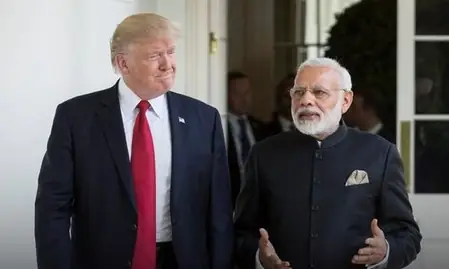
Washington, February 10. In a significant development following President Donald Trump’s announcement of a trade deal with India, the White House has confirmed that negotiations on key outstanding issues will persist. While the core elements of the interim agreement and its implementation framework have been outlined, discussions on unresolved tariffs and non-tariff barriers remain active.
This update comes from a detailed fact sheet released after last Friday’s conversation between President Trump and Prime Minister Narendra Modi. The leaders expressed mutual agreement on the structure of an interim trade pact and reaffirmed their commitment to advancing a comprehensive bilateral trade agreement in the future.
According to the White House, the two nations will continue deliberations on remaining tariff obstacles, additional non-tariff barriers, technical trade barriers, customs duties, trade facilitation, and improving regulatory frameworks. Talks will also cover services, investment, intellectual property rights, labor standards, environmental concerns, government procurement, and unfair trade practices by state-owned enterprises.
Despite ongoing discussions on sensitive topics, certain decisions under the interim deal are set for immediate implementation. President Trump has decided to remove the additional 25% duties imposed on Indian imports. This move is linked to India’s commitment to halt oil purchases from Russia, with Trump signing an executive order to this effect.
Concurrently, the US has agreed to reduce reciprocal tariffs on India from 25% to 18%, citing India’s cooperation on trade imbalances and national security matters. India has pledged to increase purchases from the US and address non-tariff barriers hindering bilateral trade. Both sides will negotiate core rules to ensure the agreement’s benefits primarily accrue to the United States and India.
Digital trade forms a crucial component of the pact. India has consented to eliminate its digital services tax and is open to establishing bilateral rules for digital commerce, including no customs duties on online transactions and avoidance of discriminatory practices.
The countries have also committed to bolstering economic security, strengthening supply chains, and promoting innovation. Collaboration in technology sectors is expected to deepen. The White House highlighted that India has historically imposed high duties on US goods, averaging 37% on agricultural products and over 100% on certain automobiles.