
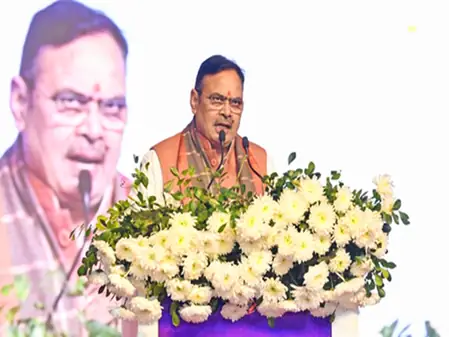
JAIPUR – Rajasthan Chief Minister Bhajan Lal Sharma declared on Monday that Ayurveda is deeply rooted in the state’s soil, with immense potential for medicinal plant production. Speaking at the golden jubilee celebrations of the National Institute of Ayurveda (NIA) here, he highlighted how the region’s hills, forests, and rich biodiversity underscore centuries-old ties to this ancient healing system.
The government, under Sharma’s leadership, is prioritizing efforts to promote Ayurveda and make it accessible to the masses. ‘Our mountains and jungles are living proof of Rajasthan’s Ayurvedic heritage,’ he emphasized, noting the institute’s evolution from a modest college in 1976 to a premier deemed university today.
Over the past 50 years, NIA has excelled in education, training, research, and patient care, earning national acclaim that fills Rajasthanis with pride. Sharma praised Ayurveda’s role alongside yoga in putting India on the global map, particularly its profound knowledge for treating seasonal ailments.
Drawing from ancient wisdom, he referenced the Vedas and sages like Charaka, Sushruta, and Vagbhata, who systematized Ayurveda. Charaka Samhita views a healthy body as the foundation of righteous living, while Sushruta is revered worldwide as the father of surgery.
Sharma lauded Prime Minister Narendra Modi’s vision of ‘Healing in India, Healing by India,’ which has revitalized traditional systems through the dedicated AYUSH Ministry. This includes declaring June 21 as International Yoga Day, boosting global recognition, increased research funding, and expanding institutions.
Ongoing initiatives aim to integrate Ayurveda into mainstream public health via hospital expansions, strengthened Panchakarma units, modernized dispensaries, and enhanced education and research opportunities. ‘Ayurveda’s resurgence is key to India’s health future,’ Sharma concluded, urging collective commitment to this timeless science.