
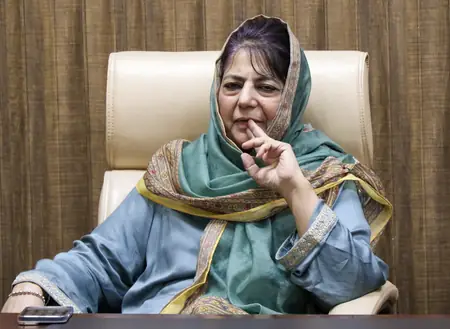
Srinagar, February 6: In a significant development for Jammu and Kashmir’s agricultural heartland, former Chief Minister and PDP president Mehbooba Mufti has expressed gratitude to Rail Minister Ashwini Vaishnaw for temporarily halting three proposed railway projects in the Kashmir Valley. The decision comes as a major relief to millions of farming families whose livelihoods were at grave risk from the original alignments cutting through fertile lands.
Mufti, in her letter to the minister, urged a complete rerouting of these projects through barren and non-arable lands. She advocated for creating a dedicated fruit corridor to safeguard farmers’ incomes, emphasizing that agriculture and horticulture form the backbone of Kashmir’s economy. Nearly two-thirds of the Valley’s population depends directly or indirectly on these sectors, yet cultivable land constitutes only a tiny fraction of the total geography.
‘This pause provides much-needed breathing space for lakhs of agricultural families,’ Mufti wrote, highlighting how highways, bypasses, and ring roads have already devoured vast swathes of productive soil in recent years. Farmers, mostly smallholders with no alternative income sources, face mounting pressures amid high youth unemployment. Recent shifts toward high-yield, capital-intensive farming make the threat even more acute.
While welcoming rail connectivity, Mufti stressed balancing development with sustainability. ‘Kashmir, like rural India, thrives in its villages,’ she noted, calling for projects to prioritize wasteland over precious farmland. This realignment would not only alleviate immediate fears but protect the sustenance of around 1.5 million families.
She also appealed for extending rail links to the resource-rich Chenab Valley and Pir Panjal regions, long plagued by unreliable road networks. These strategically vital areas have seen development stifled for over seven decades due to poor connectivity. Mufti expressed hope for prompt, empathetic action in the larger public interest, ensuring growth does not come at the cost of local livelihoods.