
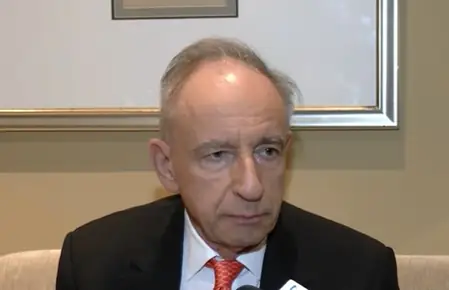
New Delhi witnessed a candid assessment from Poland’s Deputy Foreign Minister Wladyslaw Bartoszewski on Friday, as he hailed India as a formidable economic powerhouse. In an exclusive interview, Bartoszewski emphasized that under Prime Minister Narendra Modi’s leadership, India is charging towards becoming the world’s third-largest economy, currently holding the fourth spot by GDP.
“India stands as a major economic force, boasting a massive market of 1.5 billion people,” Bartoszewski stated. “No country can afford to overlook such a dynamic economy in today’s global landscape.”
Delving into trade dynamics, he commented on the prospective India-US trade deal, asserting that a Free Trade Agreement (FTA) trumps no deal at all. Tariffs, he argued, rarely foster prosperity as they ultimately burden consumers when importers pass on costs.
Turning to Poland-India ties, Bartoszewski spotlighted immense opportunities in Information and Communication Technology (ICT), which constitutes 9% of India’s GDP compared to Poland’s 7%. “Collaboration here is natural,” he noted, praising both nations’ advancements in digital governance. Poland excels in e-governance, enabling most official interactions via phone or computer, while India leads in digital innovation.
Defense cooperation emerged as another pillar, with discussions underway on military technologies, including joint production under India’s ‘Make in India’ initiative and potential ventures in Poland. Green technologies also featured prominently, from water treatment—where a Polish firm manages sewage in Mumbai—to Poland’s shift from coal to renewables, nuclear power, offshore wind, and biogas.
“Our agriculture sector, powering half our exports, offers synergies in biogas production from farm products,” Bartoszewski added. Interest extends to India’s expertise in green hydrogen and energy storage, alongside coal mining collaborations leveraging Poland’s open-pit mining experience.
This interview underscores a burgeoning strategic partnership, poised to reshape bilateral relations amid global economic shifts.