
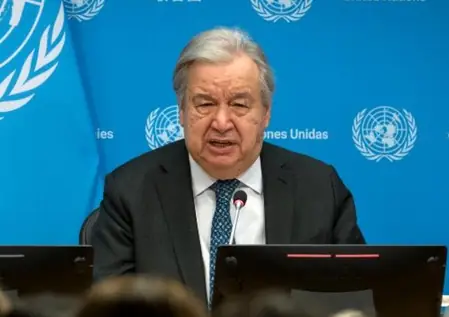
In a stark warning from United Nations headquarters, Secretary-General Antonio Guterres has labeled the expiration of the New START treaty between the US and Russia as a ‘serious moment’ for international peace and security. This landmark arms control agreement, which curbed deployed nuclear warheads and delivery systems, officially ends on Thursday, leaving the world without legally binding limits on these superpowers’ strategic arsenals for the first time in over half a century.
Guterres emphasized the gravity of this shift. Russia and the United States together control the vast majority of the globe’s nuclear stockpiles. During the Cold War and beyond, treaties like New START fostered stability, prevented miscalculations that could lead to catastrophe, and enabled the dismantling of thousands of warheads. ‘Strategic arms control has enhanced security worldwide, especially for the people of the US and Russia,’ he stated.
The timing couldn’t be worse. As nuclear rhetoric escalates and geopolitical tensions simmer, the risk of nuclear use looms larger than at any point in recent decades. Yet, Guterres sees a silver lining. ‘In this moment of uncertainty, we must find hope. This is a chance to reset and build arms control frameworks suited to our rapidly changing world,’ he urged.
He welcomed recent acknowledgments from both nations’ presidents that a nuclear arms race destabilizes the planet and must be averted. Now, the international community watches closely, demanding action over words. Guterres called on Washington and Moscow to return to the negotiating table without delay, forging a new regime with verifiable limits, reduced risks, and bolstered global security.
Signed in 2011, New START was the last major US-Russia arms control pact standing after the US withdrew from the Intermediate-Range Nuclear Forces Treaty in 2019. Its demise underscores the fraying of post-Cold War nuclear order, raising urgent questions about the future of deterrence and diplomacy in an era of multiplying threats.