
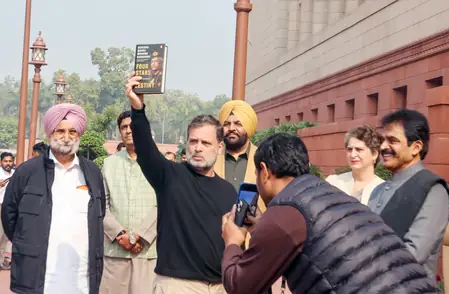
New Delhi buzzed with controversy on Wednesday as Leader of Opposition Rahul Gandhi brandished a book by former Army Chief General Manoj Mukund Naravane before the media. In a bold accusation, Gandhi asserted that Indian troops were poised to engage Chinese tanks that had intruded into Indian territory along the Kailash Range, but were shockingly abandoned by higher authorities.
Holding up the volume, Gandhi challenged skeptics who denied its existence. ‘This is the book right here,’ he declared. ‘Every young Indian must see this. It’s General Naravane’s own account, yet I’m told I can’t quote it in Parliament.’
Drawing from the book’s revelations, Gandhi recounted a tense moment when Naravane informed Defense Minister Rajnath Singh about Chinese tanks advancing deep into Indian border areas. No immediate orders came. Calls to External Affairs Minister S. Jaishankar and National Security Advisor followed, still met with silence. Finally, Singh responded that he would consult the ‘top’ leadership.
The directive that emerged was chilling: Do not fire even if Chinese forces are inside our borders without explicit permission. ‘Our army wanted to hit those tanks—they were on our soil,’ Gandhi emphasized. Instead, the message from the top was vague: ‘Do what you deem fit.’
Naravane’s words in the book paint a picture of isolation: ‘I felt truly alone. The entire system had deserted me.’ Gandhi slammed this as leadership failure, leaving brave soldiers to fend for themselves in a crisis.
The Congress leader vowed to personally hand the book to Prime Minister Narendra Modi if he appears in the Lok Sabha. This revelation reignites debates over India’s 2020 border standoff with China, questioning the chain of command and political oversight during one of the nation’s most precarious military moments.
As opposition voices grow louder, the public awaits clarity on these allegations, with implications for national security and governmental accountability stretching far beyond the pages of a single book.