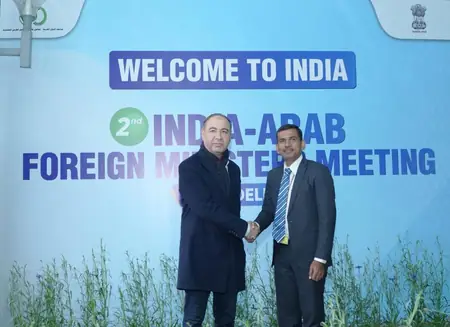
New Delhi is buzzing with diplomatic activity as world leaders converge for the second India-Arab Foreign Ministers’ Meeting (IAFMM). On Friday, several high-profile foreign ministers from Arab nations landed in the capital, setting the stage for crucial discussions on bilateral ties and regional cooperation.
Qatar’s Minister of State for Foreign Affairs, Sultan bin Saad Al Muraikhi, received a warm welcome from India’s Ministry of External Affairs (MEA). Officials highlighted how his visit will bolster the strategic partnership between the two nations, fostering deeper collaboration in key sectors.
Libya’s Foreign Minister, Eltayeb Salem Elbouri, and Somalia’s Foreign Minister, Abdisalam Ali, also arrived on Friday. The MEA expressed optimism that their participation will accelerate bilateral relations, paving the way for enhanced people-to-people contacts and economic exchanges.
Somalia’s Foreign Minister Ahmed Moalim Fiqi was greeted with enthusiasm, with MEA noting that the trip would deepen the strong bonds already existing between India and Somalia.
The arrivals follow Thursday’s influx, including League of Arab States (LAS) Secretary-General Ahmed Abul Gheit, who is attending the IAFMM and related meetings. MEA’s post on X underscored the shared commitment to a robust India-Arab partnership across all domains over the next two days.
Earlier on Thursday, Foreign Ministers from Comoros (Mbe Mohamed), Palestine (Riyad Al-Maliki, though reported as Warsen Agabekian Shahin in some updates), and Sudan (Mohieldin Salim Ahmed Ibrahim) touched down in New Delhi.
India, co-hosting with the UAE, will formally kick off the second IAFMM on Saturday. Preceding it is the fourth India-Arab Senior Officials’ Meeting on Friday. This platform, revived after a decade since its debut in Bahrain in 2016, aims to advance cooperation in economy, energy, education, media, and culture.
Institutionalized since 2002 via an MoU with LAS, the IAFMM remains the cornerstone of India-Arab dialogue. Stakeholders anticipate breakthroughs that could redefine multilateral engagements in the region, amid evolving global dynamics.