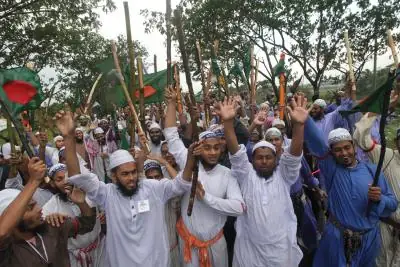
Dhaka is bracing for a fiercely contested election on February 12, but the campaign trail has taken a disturbing turn. Political parties are openly equating votes against them with votes against Islam itself. This tactic, as highlighted in a recent investigative report, is a classic ploy to brand opponents as anti-religious when their legitimacy is questioned.
Across Bangladesh, religious fervor is stifling cultural expression. Music education faces bans on faith-based grounds, shrines are under attack, theater groups receive threats, and textbooks undergo arbitrary revisions infused with ideology. Renowned columnist Hasan Firdous, writing in the leading Bengali daily Prothom Alo, traces this manipulation back decades, including its role in justifying the 1971 Pakistani army massacre of Bengali civilians.
‘The trend of exploiting religion for political gain has intensified in today’s Bangladesh,’ Firdous asserts. Many parties embed religious terms in their names, signaling their agenda clearly. Once in power, these leaders shield themselves with faith while minorities suffer first. He draws parallels to Ahmadis in Pakistan and repeated assaults on Shia mosques, noting a surge in Bangladesh where social media posts targeting minorities lead to swift backlash.
Adding to the mix, one party recently proposed slashing women’s working hours to five daily, framed as a ‘long-term strategy’ to sideline them economically and confine them to domestic roles. Meanwhile, the hardline Jamaat-e-Islami party sends mixed signals: publicly hinting it won’t impose Sharia if elected, yet its leaders advocate for it on TV, and grassroots activists pitch their scale symbol as a religious duty or even a ‘ticket to paradise.’
This glaring contradiction underscores a deeper malaise. As elections near, Bangladesh stands at a precarious crossroads, where the politicization of religion threatens democratic norms and minority rights. Voters must navigate this minefield, weighing faith against freedom in a nation still healing from its turbulent past.