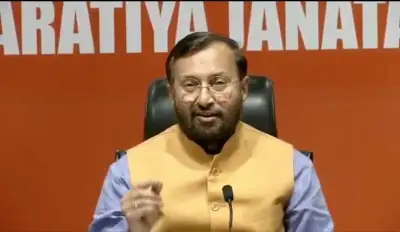
In the high-stakes world of Indian politics, few stories capture the lighter side like the time senior BJP leader Prakash Javadekar was hailed as the party’s new Muslim face. Born on January 30, 1951, in Pune, Maharashtra, Javadekar has been a steadfast warrior for the BJP since its inception, rising through the ranks with unwavering dedication.
His journey began rooted in RSS ideology. As a student at MES College of Commerce in Pune, he drew inspiration from professors like Shripati Shastri and RSS pracharak Damu Anna Date. Joining the Akhil Bharatiya Vidyarthi Parishad (ABVP) in 1969 marked his entry into active politics. By 1972, under Gopinath Munde’s leadership, he served as secretary of a student committee that honored Jayaprakash Narayan.
Javadekar’s leadership shone during turbulent times. In 1975, he was elected to the Pune University Senate. Leading ABVP, he organized satyagraha against the Emergency on December 11, 1975, across 11 colleges. Arrested and jailed in Yerwada, he launched the weekly ‘Nirbhay’ magazine for 400 political prisoners and coordinated anti-Emergency activities inspired by RSS chief Balasaheb Deoras.
Post-Emergency, Javadekar joined the BJP at its formation in 1980. Resigning from Bank of Maharashtra in 1981, he became a full-time worker, serving as general secretary of Bharatiya Janata Yuva Morcha (BJYM). He spearheaded unemployment campaigns, state-wide ‘Sangharsh Rath’ yatras, and mobilized thousands in Mumbai on March 10, 1989 – the first such rath by BJYM or BJP.
Elected to Rajya Sabha from Maharashtra in 2008, he vacated his seat in 2014 for ally Ramdas Athawale but was nominated from Madhya Pradesh. In Narendra Modi’s first cabinet, he handled Environment as Minister of State with independent charge, later Information & Broadcasting, and finally Human Resource Development as Cabinet Minister. Known as a crisis manager, he played key roles in Karnataka assembly polls and Rajasthan Lok Sabha campaigns.
But the anecdote that steals the show dates back to the Citizenship Amendment Act (CAA) protests. Amid public confusion, BJP planned meetings with Muslim leaders to clarify no Indian would lose citizenship. At a Delhi meeting with Shahnawaz Hussain present, Hussain affectionately called Javadekar ‘Javed Bhai.’ Amused attendees asked why. Hussain recounted their Jammu visit as a delegation, where local papers misspelled Javadekar as ‘Javedkar’ and dubbed him BJP’s new Muslim face for Jammu & Kashmir.
The nickname stuck, with Hussain teasing him often. Other BJP leaders joked Javadekar should address Muslim communities as ‘Javed Bhai.’ This charming mix-up highlights Javadekar’s versatility and the camaraderie in BJP ranks, underscoring his enduring legacy as a dedicated party soldier.