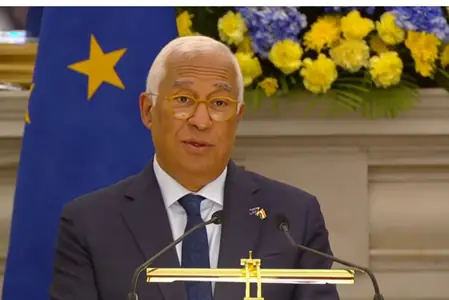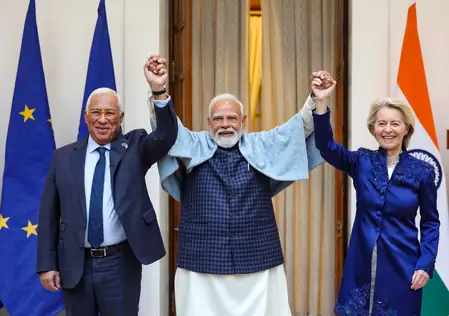

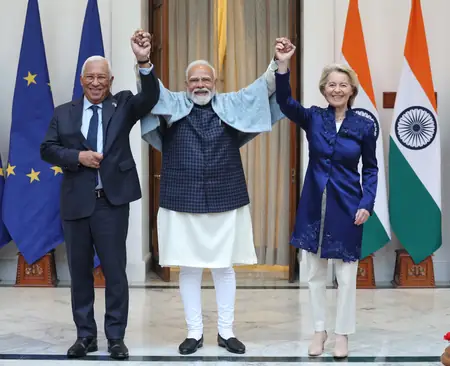
New Delhi witnessed a pivotal moment in global diplomacy as Prime Minister Narendra Modi, European Council President Antonio Costa, and European Commission President Ursula von der Leyen convened for the 16th India-EU Summit on Tuesday. The leaders reaffirmed their commitment to elevating the strategic partnership grounded in shared values like democracy, human rights, pluralism, rule of law, and a rules-based international order centered on the United Nations.
Co-chairing the summit, the trio emphasized tackling security threats head-on, promoting inclusive and sustainable development, bolstering economic resilience and security, accelerating action on climate and biodiversity, and fast-tracking progress toward Sustainable Development Goals (SDGs). The joint statement released after in-depth discussions highlighted these priorities with remarkable clarity.
Costa and von der Leyen arrived as chief guests for India’s 77th Republic Day celebrations at Modi’s invitation, accompanied by a high-level delegation including High Representative Kaja Kallas for Foreign Affairs and Security Policy and Trade Commissioner Maros Sefcovic.
A landmark achievement was the signing of the India-EU Security and Defence Partnership, the first comprehensive framework of its kind between the two sides. This pact will deepen ties in maritime security, defence industry and technology, cyber and hybrid threats, space, and counter-terrorism cooperation. Discussions also kicked off on an Information Security Agreement to streamline classified information exchange, further fortifying defence collaboration.
The leaders stressed the need for a robust, effective multilateral system with the UN at its core, calling for comprehensive UN Security Council reforms to make it more representative, inclusive, transparent, effective, democratic, and aligned with contemporary geopolitical realities.
Recognizing the interconnected security and prosperity of Europe and the Indo-Pacific, they recommitted to a free, open, peaceful, and prosperous region in line with international law, particularly UNCLOS. They welcomed enhanced regional cooperation, including the inaugural India-EU Indo-Pacific Consultation in New Delhi, and pledged to strengthen ties under the Indo-Pacific Oceans Initiative (IPOI) and Indian Ocean Rim Association (IORA).
On Ukraine, they expressed deep concern over the ongoing war’s humanitarian toll and global repercussions, supporting sustained efforts for comprehensive, just, and lasting peace through dialogue and diplomacy per the UN Charter and international law.
Discussions touched on Iran and recent Middle East tensions, underscoring dialogue and diplomacy for peaceful resolutions. Regarding Gaza, they hailed UNSC Resolution 2803 of 17 November 2025, welcoming the Peacekeeping Board and international stabilization force authorization. They urged full implementation by all parties, unimpeded humanitarian aid, and a just, lasting peace via a two-state solution.
In a strong stance against terrorism, the leaders unequivocally condemned all forms, including cross-border terror, the 22 April 2025 Pahalgam attack in Jammu-Kashmir, and the 10 November 2025 incident near Delhi’s Red Fort. They called for decisive, coordinated global action and enhanced cooperation to counter radicalization, terror financing, money laundering, misuse of emerging tech, and recruitment.
This summit marks a new era of India-EU synergy, poised to shape global security and prosperity.