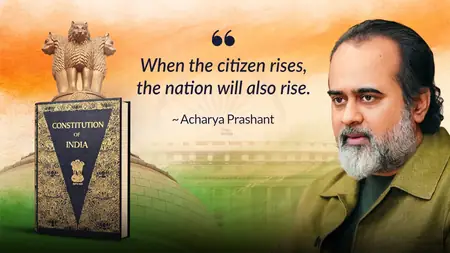
New Delhi, January 25 – As India prepares to celebrate its 77th Republic Day, philosopher and author Acharya Prashant delivered a profound message emphasizing that true republicanism extends far beyond constitutional frameworks. He asserted that the real power of a republic lies in the inner awakening of its citizens.
Prashant explained the essence of a republic, stating, ‘A republic means no external force – no king, queen, or inherited tradition – rules over you. The people, or ‘gan,’ create their own system, which is why republic and democracy go hand in hand.’
However, he warned of a deeper threat lurking within. ‘Just as it’s vital to prevent external rulers, it’s equally crucial that our primal instincts, unexamined beliefs, and ego do not dominate us from inside,’ he said. He highlighted how internal ignorance can be more dangerous than any foreign invader exploiting our weaknesses.
Reflecting on the Preamble of the Indian Constitution, Prashant called it the ‘spiritual heart’ of the document. ‘We, the people of India, solemnly resolve to adopt this Constitution,’ he quoted, interpreting it as a declaration of self-determination. ‘It means we won’t let anyone impose over us; it’s our resolve, not compulsion, and we dedicate ourselves to self-chosen living.’
Drawing from the Bhagavad Gita, he illustrated the link between inner and outer freedom. ‘On the battlefield of Kurukshetra, facing an external war, Lord Krishna imparts inner knowledge to Arjuna, not battle tactics. True inner freedom makes one impervious to external enslavement.’
Prashant critiqued how ordinary ego resists constitutional ideals like socialism, secularism, fraternity, equality, and liberty. ‘These lofty principles reveal the spiritual foundation of our Constitution. Can sovereignty, socialism, or secularism exist without inner light?’ he questioned.
On democracy, he cautioned, ‘Without an awakened common man, democracy devolves into mob rule.’ He dissected socialism: ‘People feel happy only by comparing wealth with neighbors.’ Ego-driven sectarianism undermines secularism, turning noble words into hollow shells without inner illumination.
Addressing the youth, Prashant urged, ‘A nation is its people, the ‘gan.’ Elevate yourselves.’ He stressed that greatness can’t be delegated to the past or elites; the common person must rise.
Defining spirituality simply, he said, ‘It’s about self-observation – not sheltering weaknesses, flaws, or bonds.’ When ordinary Indians embrace this, India will rapidly become a great nation the world learns from, realizing ‘Vasudhaiva Kutumbakam’ – the world as one family.
He distinguished Indian nationalism as non-violent and welfare-oriented, unlike aggressive forms elsewhere, rooted in constitutional benevolence for all humanity.
Concluding, Prashant emphasized, ‘Ultimately, it boils down to the human. Our Constitution demands strong, elevated, self-aware individuals. When Indians excel, making India great becomes effortless.’