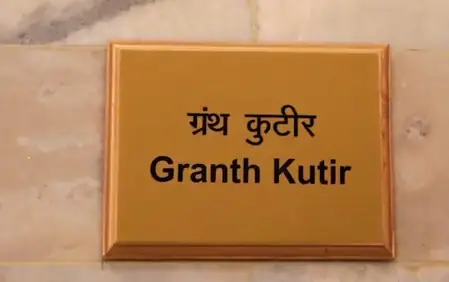
In a momentous celebration of India’s linguistic heritage, President Droupadi Murmu inaugurated the Granth Kutir at Rashtrapati Bhavan on Saturday. This exquisite library houses an impressive collection of 2,300 books and manuscripts in India’s 11 classical languages: Tamil, Sanskrit, Kannada, Telugu, Malayalam, Odia, Marathi, Pali, Prakrit, Assamese, and Bengali.
The Granth Kutir stands as a testament to the nation’s profound cultural, philosophical, literary, and intellectual legacy. Spanning epic poetry, philosophy, linguistics, history, governance, science, and devotional literature, the collection even includes translations of the Indian Constitution in these ancient tongues. Among its treasures are nearly 50 rare manuscripts inscribed on traditional materials like palm leaves, paper, bark, and cloth.
Developed through collaborative efforts involving the central government, state administrations, universities, research institutes, cultural organizations, and generous individual donors, the project has received strong backing from the Ministries of Education and Culture. The Indira Gandhi National Centre for the Arts provides expert guidance on manuscript management, preservation, documentation, and display.
The initiative aims to ignite public awareness about India’s rich cultural and literary inheritance, aligning with the national resolve to eradicate colonial mindsets. By showcasing seminal works, Granth Kutir fosters a sense of unity in diversity and supports the Gyan Bharatam Mission, a nationwide endeavor to preserve, digitize, and disseminate India’s vast manuscript heritage, blending tradition with technology for future generations.
Previously, the space held colonial-era items like William Hogarth’s original works, speeches by Lord Curzon, and other British administrative texts. These have been relocated within the Rashtrapati Bhavan complex, digitized, and made available online for researchers.
Visitors on the Rashtrapati Bhavan Circuit 1 guided tours will now glimpse these artifacts and manuscripts. An online portal will offer access to the collection, allowing the public to read books and manuscripts digitally. Researchers can apply for in-person access through the portal.
Highlighting ancient masterpieces, the collection features Sanskrit’s Vedas, Puranas, and Upanishads; Marathi’s Gatha Saptasati; Pali’s Vinaya Pitaka outlining monastic rules; Prakrit’s Jaina Agamas and inscriptions; the Charyapada in Assamese, Bengali, and Odia; Tamil’s Tirukkural; Telugu’s Mahabharata; Kannada’s Kavirajamarga on poetics and grammar; and Malayalam’s Ramacharitam.
Addressing the gathering post-inauguration, President Murmu emphasized that these classical languages form the bedrock of Indian culture. ‘Works in science, yoga, Ayurveda, and literature from these languages have guided the world for centuries,’ she said. Classics like Tirukkural and Arthashastra remain relevant today, underpinning advancements in mathematics, astronomy, medicine, and grammar by luminaries like Panini, Aryabhata, Charaka, and Sushruta.
These languages have profoundly shaped modern Indian tongues, earning their classical status to honor their contributions and promote preservation. ‘The treasure of knowledge in these languages inspires us to learn from our rich past and build a bright future,’ the President noted, stressing heritage and progress as guiding principles.
Urging collective responsibility, she called for promoting classical language studies in universities, encouraging youth to learn at least one, and stocking libraries with more such books. Granth Kutir represents Rashtrapati Bhavan’s ongoing efforts in this domain, with the President expressing confidence that the collection will grow and inspire visitors, especially the young, to explore these languages.