In a significant boost to India-Japan ties, Indian passport holders can now travel to seven additional countries using a valid Japanese visa. This policy shift, announced following high-level talks in New Delhi, promises to save time and money for Indian travelers eyeing Europe, Asia, the Middle East, and North America.
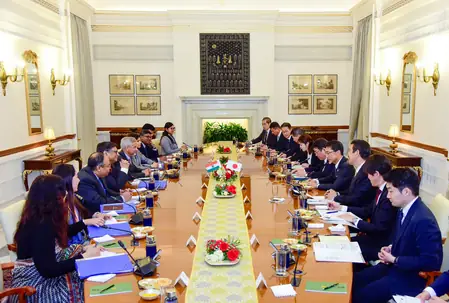
Japanese Foreign Minister Toshimitsu Motegi recently concluded a three-day visit to India, where he held crucial discussions with his counterpart S. Jaishankar. The meeting underscored the deepening strategic partnership between the two Indo-Pacific giants amid global geopolitical turbulence.
Under the new visa arrangement, a valid Japan visa allows Indian citizens to visit Georgia, Philippines, Singapore, United Arab Emirates, Taiwan, Montenegro, and Mexico, subject to each country’s conditions. This transit-friendly policy is set to revolutionize travel for Indians, making international journeys smoother and more accessible.
The timing couldn’t be better as India and Japan approach the 75th anniversary of their strategic partnership in 2027. This year also marks the 10th anniversary of Japan’s Free and Open Indo-Pacific (FOIP) strategy, which both nations are committed to advancing.
Key outcomes from the talks include the greenlight for a Japan-India Private-Sector Dialogue on Economic Security, slated for launch in the first quarter of 2026. The dialogue will prioritize five critical sectors: semiconductors, critical minerals, information and communication technology (ICT), clean energy, and pharmaceuticals. Aimed at reducing global dependencies, it ensures stable supplies of rare earths for batteries and chips essential to both economies.
Collaboration in artificial intelligence received a major push through the Japan-India AI Cooperation Initiative (JAI), with plans to establish a Japan-India AI Strategic Dialogue for expanded cooperation. The ministers also reaffirmed Quad commitments, emphasizing shared priorities in maritime domain awareness, secure sea lines of communication, and robust infrastructure development.
This multifaceted agreement not only eases travel but fortifies economic and security ties, positioning India and Japan as pivotal players in a stable Indo-Pacific region.