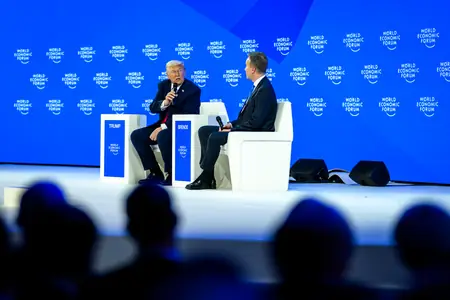
Davos, Switzerland – Leading tech executives at the World Economic Forum (WEF) 2026 have dismissed fears that artificial intelligence (AI) will wipe out jobs. Instead, they argue AI will reshape how humans work, automating routine tasks while amplifying human capabilities.
Workera founder and CEO Kian Gohar emphasized the need for precise language when discussing AI. ‘AI isn’t a colleague,’ he stated. ‘It excels at specific tasks but can’t replicate the multifaceted nature of human roles.’ Humans juggle hundreds of responsibilities simultaneously, something AI simply can’t match.
Gohar’s comments challenge past predictions of mass job losses due to AI. Historical alarms about technological unemployment have repeatedly proven unfounded, he noted.
Hippocratic AI co-founder and CEO Munjal Shah painted a vivid future: ‘Imagine a world with 8 billion people and 80 billion AI systems.’ These systems won’t replace workers but will handle mundane chores, freeing humans for higher-value work.
Shah shared a real-world example: During a heatwave, an AI system called thousands, advising people to seek cooler spots and providing health tips. ‘Rigorous testing is key,’ he added. Advanced models now audit each other, ensuring reliability.
Amini founder and CEO Kate Kallot stressed that AI remains a tool, lacking human judgment, ethics, or contextual understanding. ‘It can’t decide right from wrong on its own.’
Boston Consulting Group CEO Christoph Schweizer described AI as feeling like a coworker at times. ‘Company success hinges on reinventing workflows, not just adopting tech.’ He urged treating AI as a core management priority, not a tech-team silo.
HP President and CEO Enrique Lores advocated balanced AI deployment. In HP’s call centers, AI occasionally errs but has boosted overall accuracy and customer satisfaction.
These insights from Davos signal a shift: AI as an ally, not an adversary, promising a more productive workforce if managed wisely.