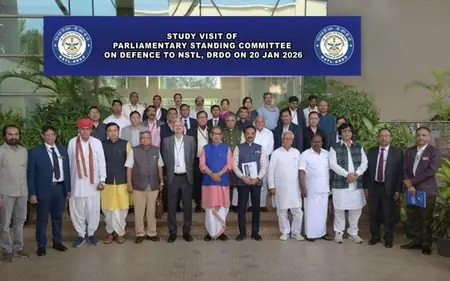
In a significant move to bolster India’s naval prowess, the Parliamentary Standing Committee on Defence, chaired by Radha Mohan Singh, visited the Naval Science and Technological Laboratory (NSTL) in Visakhapatnam on Tuesday. This inspection tour underscored the critical advancements in indigenous underwater technologies that are set to enhance the Indian Navy’s subsurface capabilities.
The committee members meticulously reviewed an array of cutting-edge products developed by NSTL, a key DRDO facility. Among the highlights were advanced torpedoes like the ALWT (Advanced Lightweight Torpedo), Varunastra, and EHWT (Extended Heavyweight Torpedo). They also examined sophisticated mines such as MIGM and PBGM, decoy systems including SFD and Turbuster, the SMART (Supersonic Missile Assisted Release of Torpedo), high-endurance autonomous underwater vehicles (HE-AUV), swarm technologies, and various underwater weapon systems.
A live demonstration at the Sea-Keeping and Maneuvering Basin test facility captivated the delegation. This state-of-the-art setup allows for hydrodynamic testing on scaled-down ship models, playing a pivotal role in evaluating the dynamics and performance of naval vessels and submersibles. The panel expressed unequivocal praise for NSTL’s R&D efforts in developing underwater platforms, weapons, and technologies tailored to the Indian Navy’s specific requirements.
Welcoming the dignitaries were Dr. Samir V. Kamat, Secretary of Defence R&D and DRDO Chairman, Dr. R.V. Hara Prasad, DG (Navy Systems & Materials), and Dr. Abraham Varghese, Director of NSTL. The director provided an in-depth briefing on ongoing R&D activities, highlighting collaborations with industry and academia. He also outlined the lab’s future technology roadmap, focusing on strategic domains like Maritime Domain Awareness and Underwater Domain Awareness—areas vital for safeguarding India’s maritime security and national interests.
The visit not only highlighted NSTL’s contributions to self-reliant defence but also reinforced the government’s commitment to Atmanirbhar Bharat in defence manufacturing. As geopolitical tensions rise in the Indian Ocean region, such indigenous innovations are indispensable for maintaining strategic superiority.