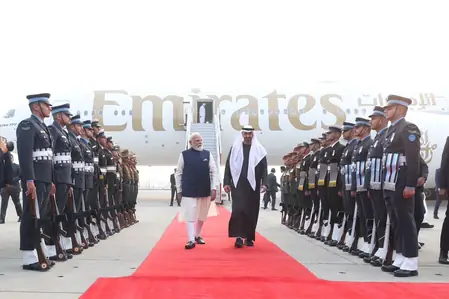
New Delhi witnessed a landmark moment in India-UAE relations as Prime Minister Narendra Modi and UAE President Sheikh Mohamed bin Zayed Al Nahyan unveiled an ambitious plan to double bilateral trade to $200 billion by 2032. The announcement came in a joint statement following their high-level meeting, signaling a new era of economic synergy between the two nations.
Since the signing of the Comprehensive Economic Partnership Agreement (CEPA) in 2022, trade volumes have surged impressively. For the fiscal year 2024-25, bilateral trade has already touched the $100 billion mark, a testament to the robust partnership. Leaders hailed recent milestones, including the 13th High-Level Investment Task Force in September 2025 and the 16th India-UAE Joint Commission Meeting in December 2025, alongside the 5th Strategic Dialogue.
A key focus was empowering micro, small, and medium enterprises (MSMEs). Directives were issued to link MSMEs from both countries through initiatives like ‘India Mart,’ ‘Virtual Trade Corridor,’ and ‘India-Africa Bridge.’ These efforts aim to boost MSME products across the Middle East, West Asia, Africa, and Eurasia, opening vast new markets.
Investment ties received a major boost with the 2024 Bilateral Investment Treaty, promising stronger flows in diverse sectors. Discussions on UAE partnership in Gujarat’s Dholera Special Investment Region were welcomed, envisioning developments like an international airport, pilot training school, MRO facilities, greenfield port, smart urban townships, rail connectivity, and energy infrastructure.
Prime Minister Modi highlighted the success of the National Investment and Infrastructure Fund (NIIF) and invited UAE sovereign wealth funds to join the second infrastructure fund planned for 2026. Progress in GIFT City was celebrated, with DP World and First Abu Dhabi Bank (FAB) establishing branches, positioning it as a global financial hub. FAB’s presence will bridge Indian firms to GCC and MENA markets.
Food security emerged as a priority, with commitments to strengthen supply chains for sustainability. Public-private partnerships, innovation, and knowledge exchange were emphasized for sustainable agriculture and national food security.
In energy, UAE’s role in India’s security was acknowledged, spotlighting the 10-year LNG deal between HPCL and ADNOC Gas for 0.5 million tons annually from 2028. Nuclear cooperation prospects, including large reactors, SMRs, and safety, were explored. Financial integration advanced with plans to link national payment platforms for faster cross-border transactions.
Space collaboration gained momentum with a joint initiative for commercialization, fostering an integrated ecosystem, joint missions, commercial services, jobs, startups, and investments. Science, technology, and AI partnerships were deepened, including supercomputing clusters and data centers in India.
This comprehensive agenda underscores a transformative partnership poised to reshape regional economics.