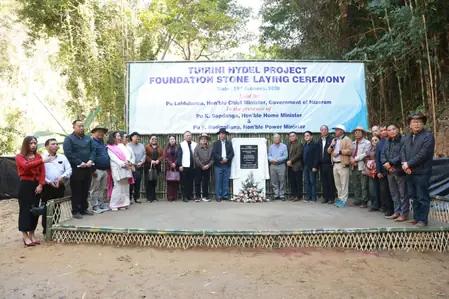
In a significant boost to Mizoram’s renewable energy ambitions, Chief Minister Lalduhoma laid the foundation stone for the 24 MW Tuirini Mini Hydropower Project in Aizawl district on Monday. This landmark initiative, funded through a loan from the Shanghai-based New Development Bank (NDB), marks a crucial step toward energy self-sufficiency in the northeastern state.
Officials revealed that the project, situated along the Tuirini River, will cost approximately 676.98 crore rupees. Speaking at the event, CM Lalduhoma highlighted the state’s recent strides in clean energy. Just last month, the 10 MW Thenzawl Solar Power Project was inaugurated, while construction on the 5 MW Sumsuih solar project is underway, with 20% completion achieved. Both solar ventures are fully owned by the state government.
The Chief Minister delved into other upcoming projects, noting that the Central Water Commission (CWC) initially designed the Tuivai Hydropower Project at 210 MW. However, concerns over reservoir flooding in neighboring Manipur led to a revised capacity of 132 MW. The Union Finance Ministry’s Department of Economic Affairs has approved the Detailed Project Report (DPR), private developer selection, bidding processes, and agreement signing. A transaction advisor has been appointed with 2.3 crore rupees allocated, and the DPR is now complete, paving the way for construction once financial closure is secured.
Lalduhoma also updated on the proposed Talawng Hydropower Project under CWC review. Geological investigations are in progress, with DPR expected by September 2026. To ramp up solar production, Expressions of Interest (EOI) have been issued for five sites, including Tumtuitlang, Serchhip Vengchhung Bawkmual, and others. Additionally, 75 gram panchayats have offered land for solar plants, with phased implementation planned.
The state has already installed 791 rooftop solar systems totaling 2.62 MW, supported by 60% central subsidies and 20-25% state incentives. These developments underscore Mizoram’s commitment to sustainable energy, reducing reliance on imports and fostering green growth.