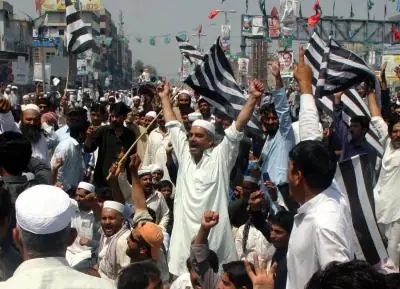

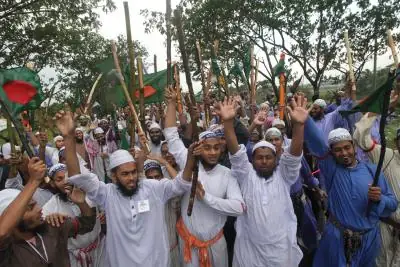
In a troubling development for Bangladesh’s fragile democracy, the resurgence of the Islamic movement known as ‘Tawhidi Janata’ is raising serious concerns among observers. According to a detailed analysis published by The Interpreter, an Australian magazine, this phenomenon isn’t manifesting as traditional organized militancy. Instead, it’s emerging as a form of coercive populism that leverages moral authority to reshape public spaces and social norms.
This mobilization thrives in environments where institutions are weakened, law enforcement is lax, and political legitimacy is in question—precisely the conditions prevailing in Bangladesh since the ouster of former Prime Minister Sheikh Hasina in August 2024. For nearly 16 years, Hasina’s Awami League government maintained control through manipulated elections, a robust security apparatus, and state-backed secular Bengali nationalism. Islamic parties and networks were suppressed, co-opted, or fragmented, confining overt religious politics to informal spheres.
Public displays of faith were tolerated, but political Islam outside state control faced strict management. This kept direct confrontations limited, though underground currents persisted. Hasina’s abrupt fall created a power vacuum, triggering not just a political void but a crisis of moral authority. Into this breach stepped Tawhidi Janata, invoking religious duty to police public behavior.
Unlike formal organizations, Tawhidi Janata operates as a loose label uniting disparate elements. Activists intervene in public spaces, monitor conduct, disrupt cultural events, and target women’s gatherings. Its strength lies in ambiguity—no clear leadership or structure means it mobilizes through crowds, symbols, and moral pressure rather than institutions. Reports highlight incidents of direct violence by its supposed supporters across the country, amplifying fears of escalating instability.
As Bangladesh navigates this transitional phase, the open yet insidious nature of Tawhidi Janata poses unique challenges. Traditional crackdowns may prove ineffective against a movement that frames its actions as pious imperatives. Policymakers and civil society must address underlying institutional frailties to prevent this coercive populism from solidifying into a new norm, potentially eroding the secular fabric long championed by the nation’s founders.